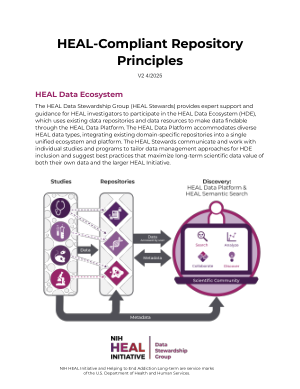
2024 Updated HEAL Repository Selection Principles
webpage
access controls
"Repositories containing sensitive information from human subjects must ensure appropriate access controls to honor consent agreements between investigators and study subjects and prevent data misuse."p.5
sustainability
"Persistence"p.3
3D Data Practices and Preservation for Humanities: A Decade of the Consortium "3D for Digital Humanities"
journalArticle · 2025 OCT 16
tagged as access controls,cybersecurity,data discovery,designated community,environmental footprint awareness,federated systems and networks,licensing and usage conditions,persistent identifiers and citations,preservation,standardized metadata,sustainability,training resources,user authentication
3D Data Repository Features, Best Practices, and Implications for Preservation Models: Findings from a National Forum
journalArticle · Jul 2020 2025-11-14
tagged as Indigenous data governance,access controls,anonymized data services,data discovery,data handling ethics,integrated deposit workflows,licensing and usage conditions,preservation,resource linking and relationships,standardized metadata,versioning
A cloud-based bioinformatic analytic infrastructure and Data Management Core for the Expanded Program on Immunization Consortium
journalArticle · 2021
tagged as access controls,curation,cybersecurity,data visitation services,versioning
A comprehensive reference architecture for trustworthy long-term archiving of sensitive data
conferencePaper · 2009
tagged as access controls,cybersecurity,data authenticity,data handling ethics,federated systems and networks,legal compliance,open format,preservation
A Data-Centric Approach for Health Care and Research in a Health Knowledge Management Platform: Implementation and Requirement-Based Evaluation Study
journalArticle · 2026
tagged as data handling ethics
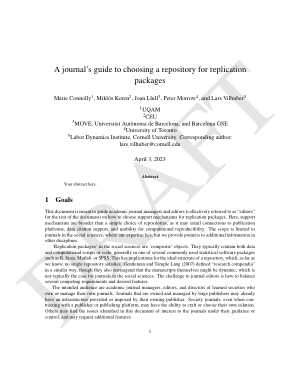
A journal’s guide to choosing a repository for replication packages [DRAFT]
conferencePaper · 2023
tagged as curation,licensing and usage conditions,persistent identifiers and citations,preservation,provenance,sustainability
A Practice of Science Data Bank on Promote the transparency of research
presentation · 2024-06-26
data usage metrics
"Integrating data metrics"p.3
integrated deposit workflows
"Integrating data submission workflow into external systems from policy makers"p.2
persistent identifiers and citations
"Persistent identifiers"p.1
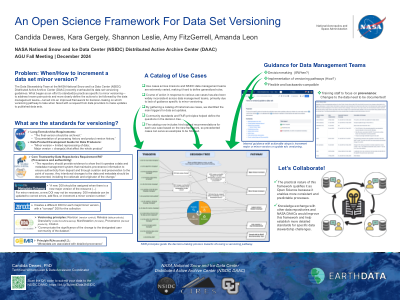
An Open Science Framework For Data Set Versioning
presentation · 2024-12-10
provenance
"Training staff to focus on provenance: Changes to the data need to be documented!"p.1
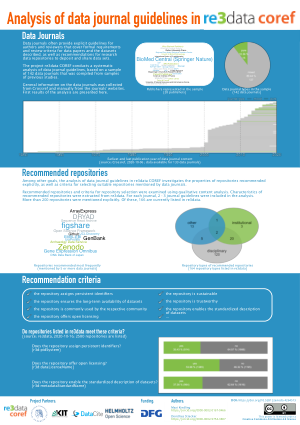
Analysis of data journal guidelines in re3data COREF
presentation · 2020-11-09
designated community
"commonly used by the respective community"p.1
licensing and usage conditions
"open licensing"p.1
persistent identifiers and citations
"persistent identifiers"p.1
preservation
"long-term availability of datasets"p.1
standardized metadata
"enables the standardized description of datasets"p.1
sustainability
"sustainable"p.1
Big data approaches to bovine bioacoustics: a FAIR-compliant dataset and scalable ML framework for precision livestock welfare
journalArticle · 2026 JAN 16
tagged as access controls,free access,persistent identifiers and citations
Biomedical Data Repository Concepts and Management Principles
journalArticle · 2024-06-13
tagged as Traditional Knowledge labels,certification,curation,cybersecurity,data accessibility,data handling ethics,data usage metrics,designated community,licensing and usage conditions,open format,persistent identifiers and citations,preservation,provenance,retention policy and processes,standardized metadata,sustainability,transparent repository governance
Centering Relationality and CARE for Stewardship of Indigenous Research Data
journalArticle · 2024-05-24T13:37:45+00:00
tagged as Indigenous community engagement,Indigenous data governance,Traditional Knowledge labels,access controls,data handling ethics,preservation,semantic interoperability
Cloud-Native Repositories for Big Scientific Data
journalArticle · 2021 MAR
data accessibility
"open access to at least three elements: the code, the software environment, and the data."p.28
sustainability
"A central challenge is funding. Academic research institutions and funding systems are not accustomed to paying for cloud computing. Structural factors, such as indirect cost policies and the three-ye"p.34
training resources
"user education and training."p.34
COAR Community Framework for Good Practices in Repositories, Version 2
report · 2022-07-19
access controls
"2.7 In cases where there is restricted access to a resource, the repository facilitates an indirect way to access this resource (e.g. by contacting the author)"p.3
"2.4 In cases where the repository is collecting sensitive research data, there are mechanisms that allow data owners to limit access to authorized users only"p.3
anonymized data services
"2.8 In cases where the repository collects sensitive data, it will recommend tools to anonymize them to enable data sharing"p.4
appraisal processes
"8.1 The repository provides public documentation that outlines the scope of the resources accepted in the repository"p.6
continuity plans
"6.7 The repository has a business continuity plan that details the response and procedures in case of natural disasters or cyber-attacks"p.5
curation
"5.2 The repository provides documentation or has a policy outlining what curation"p.4
"5.1 The repository undertakes lightweight review (and enhancement if needed) of basic metadata upon submission of the resource"p.4
cybersecurity
"4.1 The repository applies security practices to prevent unauthorised manipulation of resources"p.4
data discovery
"1.5 The repository offers a search facility"p.3
data usage metrics
"8.4 The repository collects and shares usage information using a standard methodology (e.g. number of views, downloads)"p.6
disability inclusive accessibility
"2.3 The repository supports access to its documentation and metadata for persons with disabilities."p.3
"2.9 The repository adheres to the most recent version of the W3C Web Content Accessibility Guidelines"p.4
documented APIs
"1.1 The repository enables users to apply basic Dublin Core metadata to its records, as well as more granular elements (e.g. to support multilingualism, FAIR-compliance, discipline-based, and regiona"p.3
free access
"2.1 The resources in the repository are available at no cost to the user"p.3
"1.13 The repository facilitates the use of controlled vocabularies in its metadata records 1.14 The metadata in the repository are available for download in a standard bibliographic format at no cost"p.3
high-volume data storage capacity
"2.6 The repository provides a mechanism to make very large files available to users outside of the normal user interface (in cases where the size of the file becomes unwieldy for the user)"p.3
licensing and usage conditions
"1.11 The metadata in the repository are made available under a Creative Commons public domain dedication / waiver (CC0)"p.3
"3.6 The repository provides terms of use for the resources that do not have a standard reuse license, including any reuse terms agreed to at the time of deposit"p.4
"3.1 The repository includes licensing information in the metadata record which stipulates reuse conditions for the resource"p.4
machine-actionability
"1.8 The metadata in the repository are available in human-readable and machine-readable formats"p.3
"3.2 The landing pages in the repository include metadata required for citation of the resources and are in machine-readable format"p.4
"3.3 The repository adopts Signposting to support machine access to the resources"p.4
"3.5 When resources are received in proprietary or non-machine-readable formats, the repository attempts to create versions in open, standards-compliant and machine-readable formats"p.4
"3.4 The resources are stored in machine-readable, non-proprietary formats"p.4
open format
"1.13 The repository facilitates the use of controlled vocabularies in its metadata records 1.14 The metadata in the repository are available for download in a standard bibliographic format at no cost"p.3
"3.5 When resources are received in proprietary or non-machine-readable formats, the repository attempts to create versions in open, standards-compliant and machine-readable formats"p.4
"3.4 The resources are stored in machine-readable, non-proprietary formats"p.4
"6.5 The metadata and the resources in the repository can be copied or migrated to other systems"p.5
persistent identifiers and citations
"2.2 The landing page for each resource in the repository includes a link to the resource"p.3
"1.12 In the case of research data, the repository supports identifiers for data at multiple levels of granularity, where appropriate (for example, if there there is research using a subset of the full"p.3
"1.9 The repository facilitates linking in the metadata record between related contents such as preprints, published articles, data, and software (e.g. including PIDs for related resources held elsewhe"p.3
"1.4 The repository assigns persistent identifiers (PIDs) that point to the landing page of the resource"p.3
preservation
"4.3 The repository performs integrity checks of the resources on a regular basis, in order to detect unauthorized changes or accidental damage"p.4
"6.4 The agreement between depositor and repository provides for all actions necessary to meet preservation responsibilities – e.g. rights to copy, transform, and store the items"p.5
"6.1 The repository has a digital preservation plan that states the duration of time the resources will be managed, identifies roles, and documents procedures for the preservation of different resourc"p.5
provenance
"6.3 The repository collects basic preservation metadata including provenance, date of upload, and file format"p.5
repository registry record
"1.7 The repository is included in one or more disciplinary or general registry of repositories"p.3
resource linking and relationships
"2.2 The landing page for each resource in the repository includes a link to the resource"p.3
"1.9 The repository facilitates linking in the metadata record between related contents such as preprints, published articles, data, and software (e.g. including PIDs for related resources held elsewhe"p.3
risk management
"6.7 The repository has a business continuity plan that details the response and procedures in case of natural disasters or cyber-attacks"p.5
"7.4 The repository has a publicly available policy stating what will happen to resources if operations cease"p.5
semantic interoperability
"6.8 The repository collects preservation metadata that complies with an appropriate metadata schema (e.g. PREMIS)"p.5
standardized metadata
"1.1 The repository enables users to apply basic Dublin Core metadata to its records, as well as more granular elements (e.g. to support multilingualism, FAIR-compliance, discipline-based, and regiona"p.3
"1.13 The repository facilitates the use of controlled vocabularies in its metadata records 1.14 The metadata in the repository are available for download in a standard bibliographic format at no cost"p.3
"3.2 The landing pages in the repository include metadata required for citation of the resources and are in machine-readable format"p.4
"6.8 The repository collects preservation metadata that complies with an appropriate metadata schema (e.g. PREMIS)"p.5
"6.3 The repository collects basic preservation metadata including provenance, date of upload, and file format"p.5
sustainability
"7.5 The repository (or organization that manages the repository) has a long term plan for managing and funding the repository"p.6
transparent repository governance
"7.4 The repository has a publicly available policy stating what will happen to resources if operations cease"p.5
"7.1 The repository clearly indicates what organization is responsible for its management and the nature of its governance"p.5
"8.1 The repository provides public documentation that outlines the scope of the resources accepted in the repository"p.6
user documentation
"6.4 The agreement between depositor and repository provides for all actions necessary to meet preservation responsibilities – e.g. rights to copy, transform, and store the items"p.5
user support
"7.2 The repository has a contact point to assist users and at least one staff member with the explicit responsibility of managing the services 7.3 The repository responds to queries within a reasonab"p.5
versioning
"4.2 The repository supports revision of the metadata and versioning of the resources by depositor or administrator"p.4
Committing to Data Quality Review
journalArticle · 2014-06-17
tagged as curation,data quality assurance,persistent identifiers and citations,preservation,staff expertise,sustainability
CoreTrustSeal Requirements 2026-2028
journalArticle · 2025-11-20
preservation
"R09. The repository assumes responsibility for long-term preservation and manages this function in a planned and documented way"p.18
Data Quality Assurance at Research Data Repositories
journalArticle · 2022-11-22T09:46:46+00:00
certification
"Some repositories seek formal certification to increase users’ trust in their services. Certificates can take quality assurance measures into account; for example, CoreTrustSeal asks applicants to des"p.4
curation
"In focus groups, researchers have stated that they consider quality assurance among the most important curation activities at research data repositories"p.4
data accessibility
"Accessibility Restrictions to accessing data are kept at a minimum."p.3
data authenticity
"Accuracy Data truly and unambiguously represent the phenomena they describe."p.3
data quality assurance
"In focus groups, researchers have stated that they consider quality assurance among the most important curation activities at research data repositories"p.4
licensing and usage conditions
"Open data licence Data are assigned an open licence."p.3
"Other widely applied criteria include the clarification of copyright and usage rights"p.7
open format
"Open data format Data are available in an open, nonproprietary format."p.3
provenance
"provision of provenance information"p.7
staff expertise
"For example, discipline-specific repositories may rely on data curators with a background in the respective discipline, whereas data curators at institutional repositories without a clear disciplinary"p.4
standardized metadata
"repositories should prioritise providing sufficient metadata and documentation to enable data users to evaluate the fitness of a dataset for their use case"p.3
"compliance with a metadata schema"p.7
Data quality assurance in research data repositories: a theory-guided exploration and model.
journalArticle · 2024-07-01
access controls
"Data access complies with legal requirements (e.g. copyright)"p.800
"Data access complies with ethical requirements (e.g. informed consent)"p.800
"Adequate procedures for data access, transport, and usage are in place"p.800
anonymized data services
"For instance, to ensure data privacy, providers or curators may need to anonymize a dataset by removing identifiers and/or injecting noise or irrelevant data."p.801
appraisal processes
"Product quality can be enhanced by improving the quality of the process that generates the product and/or reworking or scrapping the product (see Figure 3; Stvilia et al., 2007). The analysis showed t"p.803
certification
"the RDR attaining an external certification, such as the CoreTrustSeal certification, would indicate the RDR’s adherence to recommended practices and standards of DQA. Thus, it could signal to end-use"p.805
curation
"Repositories checked whether datasets contained plausible values for specific variables. Repositories assessed datasets for their simplicity or complexity, as well as the availability of adequate and "p.800
"Repositories checked datasets for completeness of data values and metadata elements. They also examined whether datasets were relevant to their curation scopes or measured phenomena."p.800
"Resource-rich repositories can treat datasets as products and use a complex data curation workflow. It may comprise a clearly defined division of labor with peer-review mechanisms and strong user serv"p.802
"he analysis identified division of labor and multiple roles contributing to data quality evaluation in research data curation ecosystems. DQA agents comprised RDR managers, data curators, and data lib"p.802
cybersecurity
"The first two can be categorized as data security dimensions, as they referred to efforts made to protect data from unauthorized changes and modifications."p.801
data accessibility
"Repositories checked whether datasets contained plausible values for specific variables. Repositories assessed datasets for their simplicity or complexity, as well as the availability of adequate and "p.800
"Data is accessible and available for use"p.800
"adding associated objects such as software and user guides to make the data more understandable and reusable"p.803
"providing open access to research data"p.805
data authenticity
"Data remains close to its original form and is not compressed or corrupted"p.800
data discovery
"Furthermore, when speaking about metadata quality, participants often referenced the FAIR framework to make datasets discoverable, understandable, and reusable."p.801
data handling ethics
"Data access complies with ethical requirements (e.g. informed consent)"p.800
"The most drastic DQA action is the removal of a dataset from the repository. That can be caused by the dataset not meeting the repository’s quality requirements, the provider declining to make necessa"p.804
data management planning support
"In addition to educating researchers about data management best practices and standards, some repositories affected the quality of dataset production by consulting research teams on data management pl"p.803
data quality assurance
"Repositories checked whether datasets contained plausible values for specific variables. Repositories assessed datasets for their simplicity or complexity, as well as the availability of adequate and "p.800
"Repositories checked datasets for completeness of data values and metadata elements. They also examined whether datasets were relevant to their curation scopes or measured phenomena."p.800
"Data checked for common data errors and is errorfree"p.800
"Variables and methodology are well-documented, and data limitations are noted"p.800
"Repositories that serve as data aggregators of an established network of data providers may use distributed DQ governance that is aligned with the distributed nature of their data curation workflow. F"p.802
"at require domain-specific expertise. Furthermore, some domain-specific RDRs used a peer-review process and specialized roles focused on quality assurance, such as scientific editors, for data qualit"p.802
"The analysis revealed that data quality evaluation in RDRs was often an iterative and collaborative process, where curators and/or data repository teams engaged in back-andforth interactions with depo"p.802
"In addition, most of the RDRs enabled end-users to provide data quality feedback or suggest improvements."p.802
"Product quality can be enhanced by improving the quality of the process that generates the product and/or reworking or scrapping the product (see Figure 3; Stvilia et al., 2007). The analysis showed t"p.803
"In a research network, data quality feedback and evaluations can also be communicated among network members to help harmonize the network’s DQA standards and their actual implementations."p.805
"collecting and sharing end-user feedback on the quality of data"p.805
"Most of the subject RDRs provided users with means for communicating data quality feedback to the curator(s) and/or the provider(s)."p.805
"quality rating scheme with labels or badges that explicate the repository’s DQA model and the quality of individual datasets to end-users. In order to help the Designated Community evaluate the quali"p.806
"Repositories referenced inhouse and community software they used to visualize and identify quality problems in datasets. The most frequently referenced type of software, however, was one that not only"p.806
data usage metrics
"Interview participants expressed a desire for standardized data quality communication statements. Most of the repositories enabled users to communicate data quality feedback directly using tools such "p.805
designated community
"Adopting a user-centered evaluation was also highlighted to ensure that the data was user-friendly and met the needs of potential users."p.801
"The analysis revealed that data quality evaluation in RDRs was often an iterative and collaborative process, where curators and/or data repository teams engaged in back-andforth interactions with depo"p.802
"In addition, most of the RDRs enabled end-users to provide data quality feedback or suggest improvements."p.802
"In a research network, data quality feedback and evaluations can also be communicated among network members to help harmonize the network’s DQA standards and their actual implementations."p.805
"Interview participants expressed a desire for standardized data quality communication statements. Most of the repositories enabled users to communicate data quality feedback directly using tools such "p.805
"collecting and sharing end-user feedback on the quality of data"p.805
"As with any activity, repositories’ data and metadata quality evaluation activities are shaped and mediated both by their local standards and norms, as well as by the norms, standards, and tools of st"p.806
"Participants disclosed that they used the importance or value of a dataset to their stakeholder communities to prioritize their DQA activities"p.807
licensing and usage conditions
"Data access complies with legal requirements (e.g. copyright)"p.800
"Inclusion of license information for data reuse"p.800
"Furthermore, when speaking about metadata quality, participants often referenced the FAIR framework to make datasets discoverable, understandable, and reusable."p.801
open format
"Data is available in compatible formats whenever possible"p.800
"RDR managers and data curators usually focused on augmenting metadata, including descriptive records, documentation, and labels surrounding the data, migrating datasets into more accessible or open fi"p.803
preservation
"Both data and metadata quality change over time. They need continuous maintenance to keep data reusable. These might include updating and converting datasets’ schemes, content, and metadata to align a"p.803
provenance
"Clear and well-defined provenance of data"p.800
retention policy and processes
"The most drastic DQA action is the removal of a dataset from the repository. That can be caused by the dataset not meeting the repository’s quality requirements, the provider declining to make necessa"p.804
semantic interoperability
"To make a dataset reusable, curators need to ensure the quality of its metadata. They may request and/or add metadata to a dataset to enhance its quality at both the collection and content entity leve"p.804
"Most of those reference sources were descriptive metadata schemas and vocabularies. They ranged from general descriptive metadata schemas such as MARC and MODS to domain specific metadata schemas, pro"p.806
staff expertise
"he analysis identified division of labor and multiple roles contributing to data quality evaluation in research data curation ecosystems. DQA agents comprised RDR managers, data curators, and data lib"p.802
"RDR managers and data curators usually focused on augmenting metadata, including descriptive records, documentation, and labels surrounding the data, migrating datasets into more accessible or open fi"p.803
"They also offered guidance, suggestions, and templates to help researchers complete missing information or enhance the metadata."p.803
"To make a dataset reusable, curators need to ensure the quality of its metadata. They may request and/or add metadata to a dataset to enhance its quality at both the collection and content entity leve"p.804
standardized metadata
"Metadata is complete and provides enough detail for data use"p.800
"metadata completeness"p.800
"Data are well-documented via narrative and administrative metadata"p.800
"Metadata is defined as structural data that enables specific functionality(s) on datasets. To use/ reuse a dataset in an activity, it needs to be documented with high quality metadata (Consultative Co"p.801
"RDR managers and data curators usually focused on augmenting metadata, including descriptive records, documentation, and labels surrounding the data, migrating datasets into more accessible or open fi"p.803
"To make a dataset reusable, curators need to ensure the quality of its metadata. They may request and/or add metadata to a dataset to enhance its quality at both the collection and content entity leve"p.804
"Most of those reference sources were descriptive metadata schemas and vocabularies. They ranged from general descriptive metadata schemas such as MARC and MODS to domain specific metadata schemas, pro"p.806
"metadata vocabulary"p.806
training resources
"Repositories may have less control over a data production process. Still, one way to improve the quality of the data creation process is to educate data producers/providers."p.803
"They also offered guidance, suggestions, and templates to help researchers complete missing information or enhance the metadata."p.803
user authentication
"Furthermore, repositories can affect the quality of a dataset production process indirectly by controlling the quality or credibility of their providers. Some RDRs selected and/or accepted datasets ba"p.803
user documentation
"adding associated objects such as software and user guides to make the data more understandable and reusable"p.803
"Another frequently referenced tool that repositories used to communicate DQA information to end users was user guides. In addition, to describing the semantic structure or the schema of a dataset, the"p.806
user support
"Communication is an essential part of a DQA process. There is an iterative feedback loop between the data evaluation and intervention activities (see Figure 3). DQ information can also be generated an"p.804
"Interview participants expressed a desire for standardized data quality communication statements. Most of the repositories enabled users to communicate data quality feedback directly using tools such "p.805
"Most of the subject RDRs provided users with means for communicating data quality feedback to the curator(s) and/or the provider(s)."p.805
Data quality assurance practices in research data repositories—A systematic literature review. An Annual Review of Information Science and Technology (ARIST) paper
journalArticle · 2025
appraisal processes
"Data product quality control may involve selecting and accepting datasets based on the provider's reputation, ensuring that only data from trusted depositors is curated in an RDR."p.246
"datasets due to poor quality or the depositor's refusal to make necessary adjustments, can be classified as scrap data product control"p.247
certification
"Also, an RDR seeking third-party certification and review of its data curation process can benefit from an external evaluation and validation of its DQA process design, potentially leading to process "p.249
curation
"Completeness (26) The extent to which data is a complete representation of another object, relation, process, or event"p.246
data accessibility
"Accessibility/ Availability (9) The extent to which data are available or easily and quickly retrievable"p.247
"Our analysis showed that it may include system quality characteristics such as accessibility, authenticity, integrity, and ethical and legal compliance."p.253
data authenticity
"Accuracy (26) The degree to which data is a correct or valid representation of an object, relation, process, or event"p.246
"Authenticity (2) The extent to which data is authentic and genuine"p.247
"Our analysis showed that it may include system quality characteristics such as accessibility, authenticity, integrity, and ethical and legal compliance."p.253
data handling ethics
"Ethical compliance (5) The extent to which data complies with the ethical principles of a particular community or culture, including the privacy and confidentiality of data"p.247
"Our analysis showed that it may include system quality characteristics such as accessibility, authenticity, integrity, and ethical and legal compliance."p.253
data management planning support
"RDRs may enhance the quality of data creation and documentation processes by having RDR staff collaborate with research teams to provide data management planning consultations, which include adhering "p.245
"An embedded approach can lead to higher data management and DQA literacy among the project staff, stronger collaboration to achieve the project's data management objectives, and improved local technol"p.249
data quality assurance
"Additionally, incorporating related items such as software and user guides and verifying their output and content against the data they describe significantly enhance data trustworthiness, comprehensi"p.247
"Efficient and robust DQA workflows and tools are crucial for accurately assessing and improving a dataset's quality as needed."p.248
"Additionally, creating, maintaining, and standardizing a quality assurance provenance record for datasets is crucial for assessing their reliability and usability by reusers"p.249
"Repositories employ various software tools for identifying and visualizing data quality issues and measuring data quality through metrics."p.251
"As this study's findings show, the dataset's quality can be assured at different levels, from basic quality assessment to continuous quality maintenance."p.256
designated community
"to dataset usability and accessibility can involve updating, harmonizing, and converting their schemas, content, and metadata to align with community standards and legal requirements"p.247
"Additionally, establishing user feedback mechanisms can facilitate user engagement in identifying data quality issues, thereby making the RDR's DQA process more efficient"p.249
"Another key aspect of ensuring the quality of a DQA process is for RDRs to foster strong collaboration and coordination among all stakeholders, including data providers and users, to ensure a unified "p.249
"Some RDRs enable users to offer feedback on data quality directly through means like contact forms. Others use ticket systems or implement a system for rating the quality"p.250
legal compliance
"to dataset usability and accessibility can involve updating, harmonizing, and converting their schemas, content, and metadata to align with community standards and legal requirements"p.247
"Legal compliance (3) The extent to which data complies with the laws of a particular country"p.247
"Our analysis showed that it may include system quality characteristics such as accessibility, authenticity, integrity, and ethical and legal compliance."p.253
licensing and usage conditions
"Usability/ Interpretability (6) The extent of data being usable and interpretable"p.247
open format
"RDRs may also convert datasets to more accessible or open file formats to increase their utility."p.247
preservation
"Integrity (3) The extent to which the integrity of data is preserved"p.247
"Stability (3) The extent of data remaining accurate and complete in time and space"p.247
"Finally, some RDRs conduct periodic assessments and interventions to maintain dataset quality, ensuring their actionability and stability"p.248
"Our analysis showed that it may include system quality characteristics such as accessibility, authenticity, integrity, and ethical and legal compliance."p.253
"As this study's findings show, the dataset's quality can be assured at different levels, from basic quality assessment to continuous quality maintenance."p.256
provenance
"A common data product quality intervention begins with enriching a dataset's metadata with descriptive records and comprehensive documentation, including provenance records that contextualize the data"p.247
"Additionally, creating, maintaining, and standardizing a quality assurance provenance record for datasets is crucial for assessing their reliability and usability by reusers"p.249
staff expertise
"In addition, enhancing the DQA competencies and skills of staff, along with the DQA components of an RDR's infrastructure, can significantly improve its DQA process. RDRs can achieve this through comp"p.249
"However, our analysis revealed that some studies referenced staff expertise as a target of DQA intervention activities. Available staff expertise was also included as one of the facets of DQA optimiza"p.252
standardized metadata
"to dataset usability and accessibility can involve updating, harmonizing, and converting their schemas, content, and metadata to align with community standards and legal requirements"p.247
"A common data product quality intervention begins with enriching a dataset's metadata with descriptive records and comprehensive documentation, including provenance records that contextualize the data"p.247
training resources
"They may also provide depositors with templates and guides to address information gaps and enhance metadata quality, preparing datasets for publication"p.247
user documentation
"Additionally, incorporating related items such as software and user guides and verifying their output and content against the data they describe significantly enhance data trustworthiness, comprehensi"p.247
"When depositors submit datasets, they may include information about any data quality issues in user guides or readme files."p.250
user support
"RDRs may request that depositors implement specific quality interventions on submitted datasets, or curators may perform these actions themselves. This process often entails providing depositors with "p.247
"Communication plays a crucial role in the DQA process and may involve a continuous cycle of information sharing and feedback among data quality planning,"p.249
"Another key aspect of ensuring the quality of a DQA process is for RDRs to foster strong collaboration and coordination among all stakeholders, including data providers and users, to ensure a unified "p.249
Data Repository Selection: Criteria That Matter
preprint · 2020-10-13
certification
"Certification and Community Badge"p.7
curation
"Data Curation 33,"p.8
data accessibility
"Data Access Condition 28, 29"p.7
designated community
"User Support 45"p.10
"Certification and Community Badge"p.7
legal compliance
"Data Deposition Condition"p.12
licensing and usage conditions
"Data Reuse Condition"p.13
machine-actionability
"Data and Metadata Standards"p.7
persistent identifiers and citations
"Data Contact Information"p.12
"Citation to related publications"p.12
"Persistent Identifiers for Data 38"p.9
preservation
"Data Preservation Policy 4"p.12
repository registry record
"FAIRsharing Record"p.10
reviewer access
"Data Access for Pre-Publication Review"p.11
standardized metadata
"Data and Metadata Standards"p.7
sustainability
"Resource Sustainability43, 4"p.10
transparent repository governance
"Resource Sustainability43, 4"p.10
"Status"p.10
"Data Preservation Policy 4"p.12
"Funding"p.9
versioning
"Data Versioning"p.13
Data sharing policies in scholarly publications: interdisciplinary comparisons
journalArticle · 2020
tagged as curation,endorsement,persistent identifiers and citations,preservation,data discovery,free access
Desirable Characteristics of Data Repositories for Federally Funded Research
journalArticle · 2022-04
access controls
"The repository makes use of an established and transparent process for reviewing data access requests."p.6
"The repository controls and audits access to and download of datasets."p.6
"Request Review The repository makes use of an established and transparent process for reviewing data access requests."p.6
"Download Control The repository controls and audits access to and download of datasets."p.6
"Security The repository implements and provides documentation of appropriate approaches (e.g., tiered access, credentialing of data users, security safeguards against potential breaches) to protect h"p.6
"Fidelity to Consent The repository employs documented procedures to restrict dataset access and use to those that are consistent with participant consent (such as for use only within the context of r"p.6
curation
"The repository provides or facilitates expert curation and quality assurance to improve the accuracy and integrity of datasets and metadata."p.4
"Curation and Quality Assurance The repository provides or facilitates expert curation and quality assurance to improve the accuracy and integrity of datasets and metadata."p.4
cybersecurity
"The repository has documented measures in place to meet well established cybersecurity criteria for preventing unauthorized access to, modification of, or release of data, with levels of security that"p.5
"The repository implements and provides documentation of appropriate approaches (e.g., tiered access, credentialing of data users, security safeguards against potential breaches) to protect human subj"p.6
"The repository has security measures that include a response plan for detected data breaches"p.6
"Risk Management The repository has documented capabilities for ensuring that administrative, technical, and physical safeguards are employed to comply with applicable confidentiality, risk management"p.4
"Security and Integrity The repository has documented measures in place to meet well established cybersecurity criteria for preventing unauthorized access to, modification of, or release of data, with"p.5
"Plan for Breach The repository has security measures that include a response plan for detected data breaches."p.6
data accessibility
"The repository ensures datasets are accompanied by documentation describing terms of dataset access and use (e.g., reuse licenses and need for approval by a data use committee)."p.4
data usage metrics
"The repository ensures datasets are accompanied by metadata that describe terms of reuse and provides the ability to measure attribution, citation, and reuse of data (e.g., through assignment of adequ"p.5
"Broad and Measured Reuse The repository ensures datasets are accompanied by metadata that describe terms of reuse and provides the ability to measure attribution, citation, and reuse of data (e.g., t"p.5
data use compliance
"The repository has procedures for addressing violations of terms-of-use and data mismanagement"p.6
"The repository employs documented procedures to communicate and enforce data use limitations, such as preventing reidentification or re-distribution to unauthorized users."p.6
"Accountability The repository has procedures for addressing violations of terms-of-use and data mismanagement."p.6
"Limited Use Compliant The repository employs documented procedures to communicate and enforce data use limitations, such as preventing reidentification or re-distribution to unauthorized users."p.6
free access
"The repository provides broad, equitable, and maximally open access to datasets and their metadata free of charge in a timely manner after submission"p.4
licensing and usage conditions
"The repository ensures datasets are accompanied by documentation describing terms of dataset access and use (e.g., reuse licenses and need for approval by a data use committee)."p.4
"The repository ensures datasets are accompanied by metadata that describe terms of reuse and provides the ability to measure attribution, citation, and reuse of data (e.g., through assignment of adequ"p.5
"Clear Use Guidance The repository ensures datasets are accompanied by documentation describing terms of dataset access and use (e.g., reuse licenses and need for approval by a data use committee)."p.4
"Broad and Measured Reuse The repository ensures datasets are accompanied by metadata that describe terms of reuse and provides the ability to measure attribution, citation, and reuse of data (e.g., t"p.5
open format
"The repository allows datasets and metadata to be accessed, downloaded, or exported from the repository in widely used, preferably non-proprietary, formats consistent with standards used in the discip"p.5
"Common Format The repository allows datasets and metadata to be accessed, downloaded, or exported from the repository in widely used, preferably non-proprietary, formats consistent with standards use"p.5
persistent identifiers and citations
"The repository assigns a dataset a citable, unique persistent identifier (PID or DPI), such as a digital object identifier (DOI), to support data discovery, reporting (e.g., of research progress), and"p.4
"associating submitter PIDs with those assigned to their deposited digital objects, such as datasets."p.5
"The repository ensures datasets are accompanied by metadata that describe terms of reuse and provides the ability to measure attribution, citation, and reuse of data (e.g., through assignment of adequ"p.5
"Unique Persistent Identifiers The repository assigns a dataset a citable, unique persistent identifier (PID or DPI), such as a digital object identifier (DOI), to support data discovery, reporting (e"p.4
preservation
"The repository provides documentation on policies for data retention."p.4
"Retention Policy The repository provides documentation on policies for data retention."p.4
"Long-term Technical Sustainability The repository has a plan for long-term management of data, building on a stable technical infrastructure and funding plans."p.5
provenance
"The repository has mechanisms in place to record the origin, chain of custody, version control, and any other modifications to submitted datasets and metadata."p.5
"Provenance The repository has mechanisms in place to record the origin, chain of custody, version control, and any other modifications to submitted datasets and metadata."p.5
standardized metadata
"The repository ensures datasets are accompanied by metadata to enable discovery, reuse, and citation of datasets, using schema that are appropriate to, and ideally widely used across, the communities "p.4
"The repository ensures datasets are accompanied by metadata that describe terms of reuse and provides the ability to measure attribution, citation, and reuse of data (e.g., through assignment of adequ"p.5
"Metadata The repository ensures datasets are accompanied by metadata to enable discovery, reuse, and citation of datasets, using schema that are appropriate to, and ideally widely used across, the co"p.4
sustainability
"The repository has a plan for long-term management of data, building on a stable technical infrastructure and funding plans."p.5
"ong-term Organizational Sustainability The repository has a plan for long-term management of data, including maintaining integrity, authenticity, and availability of datasets; has contingency plans "p.4
"Long-term Technical Sustainability The repository has a plan for long-term management of data, building on a stable technical infrastructure and funding plans."p.5
user authentication
"The repository supports authentication of data submitters."p.5
"The repository supports authentication of data submitters. The repository has technical capabilities that facilitate associating submitter PIDs with those assigned to their deposited digital objects, "p.5
versioning
"The repository has mechanisms in place to record the origin, chain of custody, version control, and any other modifications to submitted datasets and metadata."p.5
"Provenance The repository has mechanisms in place to record the origin, chain of custody, version control, and any other modifications to submitted datasets and metadata."p.5
continuity plans
"ong-term Organizational Sustainability The repository has a plan for long-term management of data, including maintaining integrity, authenticity, and availability of datasets; has contingency plans "p.4
data discovery
"Metadata The repository ensures datasets are accompanied by metadata to enable discovery, reuse, and citation of datasets, using schema that are appropriate to, and ideally widely used across, the co"p.4
disability inclusive accessibility
"Free and Easy Access The repository provides broad, equitable, and maximally open access to datasets and their metadata free of charge in a timely manner after submission, consistent with legal and p"p.4
Developing a standardized but extendable framework to increase the findability of infectious disease datasets
journalArticle · 2023 FEB 23
tagged as standardized metadata
Developing and managing new PID Policy at the Tarki Social Science Data Archive
presentation · 2026-01-30
tagged as persistent identifiers and citations
Digital Preservation Initiatives in Ontario: Trusted Digital Repositories and Research Data Repositories
journalArticle · 2012 2023-09-05
data authenticity
"authenticity (Is the digital object what it purports to be?)"p.1
legal compliance
"rights management (What intellectual property rights must be observed?)"p.2
licensing and usage conditions
"rights management (What intellectual property rights must be observed?)"p.2
preservation
"preservation activity (What has been done to preserve the digital"p.1
provenance
"provenance (Who has had custody/ownership of the digital object?)"p.1
staff expertise
"There are efficiencies and economies of scale when someone has developed the skills and experience to effectively ensure that data is clean and that the appropriate metadata has been developed."p.7
standardized metadata
"preservation metadata"p.1
Do Institutional Repository Deposit Guidelines Deter Data Discovery?
journalArticle · 2021 2025-11-14
tagged as standardized metadata
Do usage counts of scientific data make sense? An investigation of the Dryad repository
journalArticle · 2017
appraisal processes
"data producer reputation"p.333
curation
"data completeness"p.333
data accessibility
"accessibility"p.333
designated community
"relevancy"p.333
Earth Science Data Repositories: Implementing the CARE Principles
journalArticle · 2024-07-03T12:09:37+00:00
Indigenous community engagement
"Relevant communities should be engaged and working with the repository to define the products they need rather than the repository making assumptions."p.10
"For new data, a repository should ensure that a depositing researcher has done their due diligence and that the data are accompanied by any needed documentation. If this work has not been carried out,"p.10
"O3 Anticipate working with more communities (C2, R1)"p.11
"O1 Facilitate relationships between data provider and user communities (R1)"p.11
"Outreach activities entail not just direct communication with the repository’s communities, but also in ensuring that repository practices and protocols are transparent, justifiable, and communicated "p.11
"O8 Share materials with the Indigenous workforce (C1, A2, R2) The Indigenous materials curated by the repository (e.g., digital data, samples) need to be available to the Indigenous Peoples to which "p.12
"O7 Liaise between communities and vocabulary maintainers (A1, R3) Repositories are rarely directly involved in the development of all of the vocabularies (thesauri, ontologies, etc.) associated with "p.12
"O9 Clarify types of uses with communities (A3, E3)"p.12
"O10 Identify educational opportunities with communities (R2) One of the topics that should be discussed when working with Indigenous communities is what types of educational activities would be welco"p.12
"Operations are generally guided by repository leadership, with day-to-day procedures typically developed by the staff doing the work (e.g. data curators). Implementing CARE will impact both high level"p.13
"R7 Develop community contact protocols and follow up processes (C1, A1, R1, E3)"p.14
"R6 Develop processes to identify communities for engagement and collaboration (C1, E1, E2)"p.14
"Beyond simple backup and recovery strategies, a repository’s plans for handling Indigenous data in its care should include consultation with the affected communities"p.14
"If a repository becomes aware that they hold or are likely to hold Indigenous data in the future, it is incumbent upon them to engage with the Indigenous Peoples and communities involved (C2) in order"p.8
"S6 Be aware of changing roles/relationships over time (R1)"p.9
"S5 Understand and respect the changing needs of communities (R1)"p.9
"S4 Identify types of data of interest to communities (C3, A3, R3)"p.9
"Many Earth science repositories do not undertake ethical analysis of their operations, creating and publishing a systematic account of the benefits and harms their operations may precipitate. Without "p.9
"Ongoing engagement with Indigenous communities (C2, A1, R1, R2) If a repository becomes aware that they hold or are likely to hold Indigenous data in the future, it is incumbent upon them to engage w"p.8
Indigenous data governance
"O2 Include Indigenous representatives on repository advisory board, if relevant"p.11
"Operations are generally guided by repository leadership, with day-to-day procedures typically developed by the staff doing the work (e.g. data curators). Implementing CARE will impact both high level"p.13
"R7 Develop community contact protocols and follow up processes (C1, A1, R1, E3)"p.14
"S2 Understand Indigenous legal rights (C3, A1, E2) Indigenous Peoples have various forms of underlying customary and legal rights (A1). In the US this often comes in the form of treaties or other leg"p.8
"S7 Determine if data access restrictions are necessary (C3, A3, R3, E1) For each dataset held or expected, the repository needs to leverage the previous situational awareness approaches (S1–6) to det"p.9
Traditional Knowledge labels
"This information should be included in the metadata associated with that data (e.g., information about associated Traditional Knowledge Labels (Local Contexts, n.d.)) and may result in data obfuscatio"p.12
"application of badges such as TK Labels,"p.13
"T8 Implement badging mechanisms (E1, E3)"p.16
"T15 Display required documents, badges, proper use and limitations on landing pages (A1, C3)"p.18
access controls
"This information should be included in the metadata associated with that data (e.g., information about associated Traditional Knowledge Labels (Local Contexts, n.d.)) and may result in data obfuscatio"p.12
"R3 Develop procedures to work with depositors to address necessary restrictions (A1, E1) When acquiring Indigenous data where restrictions are necessary, the repository should work with the deposito"p.13
"T1 Enable granular embargoes (A1, A3)"p.15
"T4 Create data access control mechanisms (who/when/changing roles) (A1)"p.16
"S7 Determine if data access restrictions are necessary (C3, A3, R3, E1) For each dataset held or expected, the repository needs to leverage the previous situational awareness approaches (S1–6) to det"p.9
anonymized data services
"R3 Develop procedures to work with depositors to address necessary restrictions (A1, E1) When acquiring Indigenous data where restrictions are necessary, the repository should work with the deposito"p.13
"S8 Determine if data obfuscation is necessary (A3, R1, R3, E1) Depending on the data content there may be a legal or community preference for all or certain parts of a data set to be obfuscated (A3, "p.9
appraisal processes
"For new data, a repository should ensure that a depositing researcher has done their due diligence and that the data are accompanied by any needed documentation. If this work has not been carried out,"p.10
continuity plans
"R8 Develop continuity plans (A2, R1, E3)"p.14
"T5 Implement systems that allow transfer of responsibilities (C2, A1, A2, A3, E1, E3) As has been previously noted (see Protocols), it is a repository’s responsibility to ensure the longevity of the "p.16
"Develop continuity plans (A2, R1, E3) It is a repository’s responsibility to ensure the longevity of the data in their care (E3), no matter the circumstances, up to and including dissolution of the r"p.14
curation
"For new data, a repository should ensure that a depositing researcher has done their due diligence and that the data are accompanied by any needed documentation. If this work has not been carried out,"p.10
"R4 Develop procedures to request required documents during data submission (A1, E1) The repository must be aware of acquisition or other agreements that apply to data being deposited, to ensure that"p.13
"T6 Package data with associated, required documents (A1, E1, E3) Metadata specifications and packaging protocols should support associating contextual information permanently, in order to protect the"p.16
data handling ethics
"R3 Develop procedures to work with depositors to address necessary restrictions (A1, E1) When acquiring Indigenous data where restrictions are necessary, the repository should work with the deposito"p.13
"S7 Determine if data access restrictions are necessary (C3, A3, R3, E1) For each dataset held or expected, the repository needs to leverage the previous situational awareness approaches (S1–6) to det"p.9
"Many Earth science repositories do not undertake ethical analysis of their operations, creating and publishing a systematic account of the benefits and harms their operations may precipitate. Without "p.9
data repatriation process
"to returning the data to the Indigenous community"p.10
"repatriation of the data back to the community."p.14
"T5 Implement systems that allow transfer of responsibilities (C2, A1, A2, A3, E1, E3) As has been previously noted (see Protocols), it is a repository’s responsibility to ensure the longevity of the "p.16
data viewer
"T12 Support customized data views (C1, C2, R3) Engagement (C1, C2) and decision-making is improved when a community can access data through meaningful views (R3)."p.17
legal compliance
"S2 Understand Indigenous legal rights (C3, A1, E2) Indigenous Peoples have various forms of underlying customary and legal rights (A1). In the US this often comes in the form of treaties or other leg"p.8
licensing and usage conditions
"In the interim, repositories and metadata exchange systems should include either links to or verbatim usage restrictions and guidance, licenses, documentation, and related information pertaining to In"p.17
"T15 Display required documents, badges, proper use and limitations on landing pages (A1, C3)"p.18
"Clarify types of uses with communities (A3, E3) Another topic for discussion with Indigenous Peoples is the community’s preferences for possible data restrictions and acceptable uses, to ensure Indig"p.12
multilingual support
"T9 Use a metadata format that handles multiple languages (C1, A1, R3)"p.16
"T9 Use a metadata format that handles multiple languages (C1, A1, R3) English has become the lingua franca for science. However, in order to support inclusive local development (C1), Indigenous data "p.16
persistent identifiers and citations
"T3 Link between data, papers and other outcomes (A2)"p.15
"10 Keep a list of data “actors” and be able to link data to them (A1, E2, E3)"p.16
"T6 Package data with associated, required documents (A1, E1, E3) Metadata specifications and packaging protocols should support associating contextual information permanently, in order to protect the"p.16
preservation
"For data without agreements that are already in the repository (or that pre-date agreements), the question becomes what actions should be taken to clarify the status."p.10
provenance
"T2 Support tracking data provenance (A2, E2, E3)"p.15
"10 Keep a list of data “actors” and be able to link data to them (A1, E2, E3)"p.16
"T2 Support tracking data provenance (A2, E2, E3) Data provenance can be viewed in multiple ways, e.g., to indicate a source (where does the data come from), reuse or derivations (where has it gone), "p.15
semantic interoperability
"T11 Use community-vetted vocabularies (A1, C1, R3)"p.17
"T11 Use community-vetted vocabularies (A1, C1, R3) Data that comes from a community should be understandable and usable by that community (Eitzel et al. 2017). Well-maintained vocabularies (here, inc"p.17
standardized metadata
"O7 Liaise between communities and vocabulary maintainers (A1, R3) Repositories are rarely directly involved in the development of all of the vocabularies (thesauri, ontologies, etc.) associated with "p.12
"T9 Use a metadata format that handles multiple languages (C1, A1, R3)"p.16
"T6 Package data with associated, required documents (A1, E1, E3) Metadata specifications and packaging protocols should support associating contextual information permanently, in order to protect the"p.16
"In the interim, repositories and metadata exchange systems should include either links to or verbatim usage restrictions and guidance, licenses, documentation, and related information pertaining to In"p.17
"T11 Use community-vetted vocabularies (A1, C1, R3)"p.17
"T14 Identify metadata fields to support targeted repository technologies and tools (A2, R3, E1, E3)"p.18
training resources
"O10 Identify educational opportunities with communities (R2) One of the topics that should be discussed when working with Indigenous communities is what types of educational activities would be welco"p.12
"R9 Allocate educational funds equitably (C1, C3, R2)"p.15
transparent repository governance
"O4 Ensure repository practices are publicized and transparent (A1) The detailed day-to-day practices of the repository should be public and clearly stated (e.g., data deposit, data management, etc.),"p.11
"Outreach activities entail not just direct communication with the repository’s communities, but also in ensuring that repository practices and protocols are transparent, justifiable, and communicated "p.11
"O11 Identify types of data that cannot be supported technically (C1, R3) Some of the capabilities required to fully support the CARE Principles may not exist within a repository’s current infrastruct"p.12
"R2 Ensure data management policies are justifiable (E2, E3)"p.13
"R1 Develop data policies and acquisition/curation procedures (A1, R2, E1)"p.13
"Operations are generally guided by repository leadership, with day-to-day procedures typically developed by the staff doing the work (e.g. data curators). Implementing CARE will impact both high level"p.13
"If procedures are transparent (see the Outreach section), both depositors and relevant communities will have the knowledge to make informed decisions."p.14
"Publicize your governance protocols (A1) Repository governance protocols and policies need to be written in forms that are understandable by your designated communities. For example, this might inclu"p.11
user support
"Outreach activities entail not just direct communication with the repository’s communities, but also in ensuring that repository practices and protocols are transparent, justifiable, and communicated "p.11
"O7 Liaise between communities and vocabulary maintainers (A1, R3) Repositories are rarely directly involved in the development of all of the vocabularies (thesauri, ontologies, etc.) associated with "p.12
End users' trust in data repositories: definition and influences on trust development.
journalArticle · 2014-03-01
credible reputation
"data validity and repositories’ integrity"p.26
"The integrity of repositories was mentioned by most of the participants. Participants’ belief that organizations will be honest rather than deceitful comprises trust."p.26
"This strong belief in the repositories’ integrity is also based on users’ understanding of the repositories’ mission and commitment to society;"p.27
"The reputation of repositories was another attribute mentioned by a number of participants. Reputation plays a significant role in the trust users have in repositories and is sometimes a consideration"p.28
curation
"Almost every participant discussed documentation (e.g., codebooks, original questionnaires, or methodology) of datasets, arguing the significance of having good documentation since it is ‘‘only possib"p.28
data authenticity
"In 1996, the CPA/RLG Task Force on Archiving of Digital Information (hereafter, Task Force) argued that to be trusted, digital archives have to demonstrate that they could preserve information authent"p.19
"data validity and repositories’ integrity"p.26
"Whether the data are presented accurately (validity) constituted the most important component of the definition of trust in the context of repositories."p.26
data quality assurance
"Several participants were also aware of the internal data cleaning process of repositories and expressed their trust from this process:"p.29
"a few of the participants believed that the repositories would perform quality checks and appraisals of datasets."p.29
designated community
"Understanding users’ perspectives is particularly significant because it is directly related to the fundamental missions of repositories, which is to serve a particular user group or designated commun"p.18
"benevolence is the belief that an organization is concerned with the stakeholders’ well-being"p.23
preservation
"In 1996, the CPA/RLG Task Force on Archiving of Digital Information (hereafter, Task Force) argued that to be trusted, digital archives have to demonstrate that they could preserve information authent"p.19
"digital object management that includes ingest (acquisition and creation of archival information package [AIP]), preservation planning, AIP preservation, and information and access management;"p.21
"PA14 acknowledged the value and mission of the repositories, noting that ‘‘the value of having things like that at [the repository], is that they are concerned with long-term preservation’’. Similarly"p.27
staff expertise
"Participants believed that the staff ‘‘were well trained in this area’’ (PA01), ‘‘have expertise’’ (PB10), and ‘‘are the best possible people working on it’’"p.27
transparent repository governance
"the repository has associated policies, standards, and technology infrastructure that provides the framework for digital preservation;"p.20
"organizational infrastructures that include governance and organizational visibility, organizational structure and staffing, procedural accountability and preservation, financial sustainability, contr"p.21
"identification refers to stakeholders’ understanding of an organization’s intention or interests based on shared values and commitment"p.23
"Integrity is the belief that an organization will act fairly and ethically;"p.23
Equitable Digital Systems Research Report
document
disability inclusive accessibility
"A system can be made up of completely accessible tools and still be inaccessible. Both tools and systems can be disabling where bias, inaccessibility, and attitudes, such as thinking of people with di"p.12
"Inaccessible interfaces"p.14
"All systems must be operable by assistive technologies and people with diverse needs."p.7
multilingual support
"It is important to welcome and acknowledge multiple forms of communication, as well as the additional challenges associated with ESL and language barriers. Additionally, tactile, non-verbally focused "p.29
risk management
"Standards must look forward to what we cannot predict or know with flexibility, adaptability, and emergency preparedness plans."p.7
staff expertise
"All technology and information technology departments responsible for maintaining centralized systems need to be aware of accessibility features and interoperability of assistive technologies (ATs) wi"p.8
Essential requirements for the governance and management of data trusts, data repositories, and other data collaborations
journalArticle · 2023-09-20
Indigenous data governance
"The data trust, data repository, or data collaboration must acknowledge and respect Indigenous Data Sovereignty."p.5
access controls
"Data users must complete privacy and security training before they access data. 4b) Data users must acknowledge that there may be consequences for non-compliance."p.6
cybersecurity
"There must be policies, processes, and/or procedures for cybersecurity and data protection safeguards which are reviewed and updated regularly."p.5
data discovery
"There must be policies, processes and/or procedures to create and maintain metadata and data documentation which provides sufficient information for potential users to find, understand, use, and reus"p.5
data sovereignty
"The data trust, data repository, or data collaboration must acknowledge and respect Indigenous Data Sovereignty."p.5
designated community
"There must be ongoing engagement with stakeholders. 5b) Stakeholder engagement must include ongoing engagement with members of the public. 5c) Where there is a reasonable expectation that specific s"p.8
legal compliance
"The data trust, data repository, or data collaboration must fulfill all legal requirements including, as required, authority(ies) to collect, retain, use, disclose, and/or destroy data."p.3
standardized metadata
"There must be policies, processes and/or procedures to create and maintain metadata and data documentation which provides sufficient information for potential users to find, understand, use, and reus"p.5
transparent repository governance
"Governance must be adaptive and responsive to risks, opportunities, and the concerns of stakeholders."p.5
"There must be well-defined policies, processes, and procedures covering the entire data lifecycle."p.5
"The data trust, data repository, or data collaboration must be transparent about its purpose, governance body membership, data holdings, policies regarding who has access to what data for what purpos"p.5
"The data trust, data repository, or data collaboration must have an accountable governance body that is answerable for its decisions."p.5
"The data trust, data repository, or data collaboration must have a stated purpose that specifically addresses why its activities are necessary and/or beneficial."p.5

EU Grants: AGA — Annotated Grant Agreement
document · 01 April 2025
access controls
"Trusted repositories have specific provisions in place and offer explicit information online about their policies, which define their services (e.g. acquisition, access, security of content, long-term"p.387
anonymized data services
"They meet generally accepted international and national criteria for security to prevent unauthorized access and release of content and have different levels of security, depending on the sensitivity "p.388
certification
"certified repositories, such as those certified by international organisations or government-authorised certification bodies (e.g. CoreTrustSeal, nestor Seal DIN31644, ISO16363)"p.387
curation
"Trusted repositories have specific provisions in place and offer explicit information online about their policies, which define their services (e.g. acquisition, access, security of content, long-term"p.387
"They have mechanisms or provisions for expert curation and quality assurance for the accuracy and integrity of datasets and metadata, as well as procedures to liaise with depositors where issues are "p.388
cybersecurity
"Trusted repositories have specific provisions in place and offer explicit information online about their policies, which define their services (e.g. acquisition, access, security of content, long-term"p.387
"They meet generally accepted international and national criteria for security to prevent unauthorized access and release of content and have different levels of security, depending on the sensitivity "p.388
data accessibility
"provide broad, equitable and ideally open access to content free at the point of use, as appropriate, and respect applicable legal and ethical limitations."p.388
data authenticity
"display specific characteristics of organisational, technical and procedural quality, such as services, mechanisms and/or provisions that are intended to secure the integrity and authenticity of thei"p.387
data discovery
"They ensure that contents are accompanied by metadata sufficiently detailed and of sufficiently high quality to enable discovery, reuse and citation and contain information about provenance and licens"p.388
data handling ethics
"provide broad, equitable and ideally open access to content free at the point of use, as appropriate, and respect applicable legal and ethical limitations."p.388
data quality assurance
"display specific characteristics of organisational, technical and procedural quality, such as services, mechanisms and/or provisions that are intended to secure the integrity and authenticity of thei"p.387
"They have mechanisms or provisions for expert curation and quality assurance for the accuracy and integrity of datasets and metadata, as well as procedures to liaise with depositors where issues are "p.388
data use compliance
"Trusted repositories have specific provisions in place and offer explicit information online about their policies, which define their services (e.g. acquisition, access, security of content, long-term"p.387
designated community
"disciplinary or domain repositories commonly used and endorsed by the research communities, and which are recognised internationally"p.387
endorsement
"and endorsed"p.387
free access
"provide broad, equitable and ideally open access to content free at the point of use, as appropriate, and respect applicable legal and ethical limitations."p.388
legal compliance
"provide broad, equitable and ideally open access to content free at the point of use, as appropriate, and respect applicable legal and ethical limitations."p.388
licensing and usage conditions
"They ensure that contents are accompanied by metadata sufficiently detailed and of sufficiently high quality to enable discovery, reuse and citation and contain information about provenance and licens"p.388
machine-actionability
"Their metadata is machine-actionable and standardized (e.g. Dublin Core, Data Cite, etc) preferably using common non-proprietary formats and following the standards of the respective community the rep"p.388
open format
"Their metadata is machine-actionable and standardized (e.g. Dublin Core, Data Cite, etc) preferably using common non-proprietary formats and following the standards of the respective community the rep"p.388
persistent identifiers and citations
"They ensure that contents are accompanied by metadata sufficiently detailed and of sufficiently high quality to enable discovery, reuse and citation and contain information about provenance and licens"p.388
"They assign persistent unique identifiers to contents (e.g. DOIs, handles, etc), such that the contents (publications, data and other research outputs) are unequivocally referenced and thus citeable."p.388
preservation
"display specific characteristics of organisational, technical and procedural quality, such as services, mechanisms and/or provisions that are intended to secure the integrity and authenticity of thei"p.387
"They have mechanisms or provisions for expert curation and quality assurance for the accuracy and integrity of datasets and metadata, as well as procedures to liaise with depositors where issues are "p.388
"facilitate mid- and long-term preservation of the deposited material."p.388
provenance
"They ensure that contents are accompanied by metadata sufficiently detailed and of sufficiently high quality to enable discovery, reuse and citation and contain information about provenance and licens"p.388
standardized metadata
"Their metadata is machine-actionable and standardized (e.g. Dublin Core, Data Cite, etc) preferably using common non-proprietary formats and following the standards of the respective community the rep"p.388
"They ensure that contents are accompanied by metadata sufficiently detailed and of sufficiently high quality to enable discovery, reuse and citation and contain information about provenance and licens"p.388
sustainability
"Trusted repositories have specific provisions in place and offer explicit information online about their policies, which define their services (e.g. acquisition, access, security of content, long-term"p.387
user support
"They have mechanisms or provisions for expert curation and quality assurance for the accuracy and integrity of datasets and metadata, as well as procedures to liaise with depositors where issues are "p.388
Evaluation and tagging of dkNET listed repositories repositories
webpage
tagged as persistent identifiers and citations
FIDELIS TTRAMatrix v01.00 Introduction and Overview
report · 2025-09-25
machine-actionability
"One critical factor in mutual understanding and interoperability is that a desire for machine actionability drives the move from less structured prose text towards structured metadata. This also helps"p.8
First Nations Data Governance Strategy
blogPost
data repatriation process
"Determine access and holdings protocols and/or data repatriation agreements into First Nations’ jurisdiction as chosen by rights holders"p.58
Five Suggestions Towards User-Centred Data Repositories in the Social Sciences
journalArticle · 2024-04-15T11:17:49+00:00
appraisal processes
"Reuse of qualitative data heavily depends on the trust reusers choose to grant to specific datasets, a process that is inherently connected with an assessment of the primary researchers’ worldview, re"p.5
curation
"Per dataset, it consistently includes a concise abstract outlining the research objectives, mentions the affiliated institutions of the researchers, provides a brief overview of the dataset’s variable"p.5
data handling ethics
"By solely uploading this guide, the researcher indicates which qualitative data are available without having to pass through ethics committees and without having to take the privacy of the interviewee"p.6
data quality assurance
"Reuse of qualitative data heavily depends on the trust reusers choose to grant to specific datasets, a process that is inherently connected with an assessment of the primary researchers’ worldview, re"p.5
data usage metrics
"Finally, repositories should include systematic updates and news about specific datasets when they are downloaded and reused"p.5
designated community
"Secondly, it seems appropriate to provide a space in which individual researchers can express their epistemological uncertainties to the public (e.g., as part of the metadata) and where they are encou"p.5
"It also seems advisable to insert a comment section under each dataset, in which users can publicly post questions regarding the data. Such interactions could supersede or complement the common practi"p.5
persistent identifiers and citations
"A repository should, additionally, find a way to keep track of the experts and data creators in case they change institutions. As a good practice, refer to The Finnish Social Science Data Archive, whe"p.4
semantic interoperability
"Given the inherent diversity in the forms of the metadata required to describe qualitative and quantitative data, repositories should avoid requiring the use of the same metadata fields for qualitativ"p.5
staff expertise
"First, they can put forward their own clear vision that provides answers to the identified epistemological uncertainties. Then it is up to the researchers to position themselves against that vision. I"p.5
standardized metadata
"Given the inherent diversity in the forms of the metadata required to describe qualitative and quantitative data, repositories should avoid requiring the use of the same metadata fields for qualitativ"p.5
"Repositories should aim to prevent the two main challenges with metadata: poor documentation and insufficient descriptions."p.5
training resources
"pedagogical modules should be offered. We advocate more collaboration with higher education teachers who teach statistics or research methods for the development of suitable learning modules."p.4
"First, they can put forward their own clear vision that provides answers to the identified epistemological uncertainties. Then it is up to the researchers to position themselves against that vision. I"p.5
transparent repository governance
"First, they can put forward their own clear vision that provides answers to the identified epistemological uncertainties. Then it is up to the researchers to position themselves against that vision. I"p.5
user support
"Data repositories can be thoroughly improved if seen as an important meeting place for researchers, thus facilitating as much as possible the contacts between primary and secondary users, especially i"p.4
versioning
"Moreover, it offers a comprehensive overview of different versions and related publications per dataset."p.5
Functional Requirements for Research Data Repositories
journalArticle · 2018-03-31
access controls
"Data access Choose levels of data access"p.31
"Data access"p.33
"Allow download restrictions, block unlimited downloads (allow clicking by file name)"p.34
curation
"Data and product quality Capture “degree of confidence” on each data item"p.31
"Provide tools for managing data completeness and product quality (bit preservation, replication, checksum of data, metadata completeness, accuracy, correctness)"p.33
cybersecurity
"Provide information on system security features"p.34
data accessibility
"Submission / Ingestion / Management Support remote access and management of the repository (+12)"p.31
data discovery
"Data organization Allow collection virtualization and logical naming"p.31
"User interface Individual and organization-wide collections"p.31
"Manual and automatic search"p.33
"User interface"p.34
"Data organization"p.34
data quality assurance
"Data and product quality Capture “degree of confidence” on each data item"p.31
"Provide tools for managing data completeness and product quality (bit preservation, replication, checksum of data, metadata completeness, accuracy, correctness)"p.33
"Data and product quality"p.34
data usage metrics
"Publication Provide data access statistics"p.31
"Provide data access statistics Provide information for bibliographic citation, allow the export of bibliographic data to citation software"p.33
"Support data download; provide download API"p.33
data visitation services
"Location Support for high performance computing and tight integration with data processing"p.31
integrated deposit workflows
"Integration Support interoperation among individual data management systems"p.31
"Support convenient submission and integration with external publishers"p.33
open format
"Support data download; provide download API"p.33
"Support accessible data conversion formats"p.34
persistent identifiers and citations
"Identifiers PID assignment for data management"p.31
"Identifiers"p.32
"Maintain citations linked to the data"p.33
preservation
"Preservation and sustainability Maintain a permanent history of versions for all data"p.31
"Maintain a permanent history of versions for all data"p.34
semantic interoperability
"Support for different metadata schemas, support for domain-specific metadata, allow extended metadata for interoperability"p.32
standardized metadata
"Metadata Support for different metadata schemas"p.31
"Metadata"p.32
transparent repository governance
"Policy support Allow use of policies for data processing, quality management, etc."p.31
user authentication
"Authentication and authorization Provide integration with external systems"p.31
"Authentication and authorization"p.32
versioning
"Preservation and sustainability Maintain a permanent history of versions for all data"p.31
"Support multiple data versions"p.33
"Maintain a permanent history of versions for all data"p.34
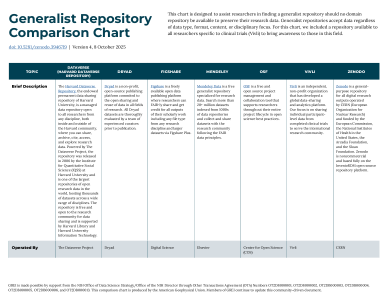
Generalist Repository Comparison Chart
journalArticle · 2025-10-08
cost transparency
"Costs to the Research"p.2
"Costs to the Researcher"p.2
access controls
"Managed Access"p.9
"Embargo"p.9
anonymized data services
"Anonymized Human Subject Research Data"p.9
certification
"Certification"p.10
data usage metrics
"Normalized Usage Statistics and Supported Data Use Metrics"p.8
"Usage Statistics"p.8
free access
"Free Access to Data"p.4
funder information
"Funder ID(s)"p.7
"Grant ID(s)"p.7
high-volume data storage capacity
"Size Limits"p.3
licensing and usage conditions
"Licensing Options"p.3
machine-actionability
"Machine Interoperability"p.8
open format
"Formats Supported for Metadata Export"p.6
persistent identifiers and citations
"Author Identifiers"p.6
"Persistent Unique Identifiers for Records"p.6
"Author Organization Affiliation"p.7
preservation
"Preservation"p.4
repository registry record
"RRID Record"p.10
"re3data Record"p.10
"FAIRsharing Record"p.10
resource linking and relationships
"Links to Related Material"p.7
retention policy and processes
"Retention Policy"p.5
reviewer access
"Peer Review Access"p.9
semantic interoperability
"Supported Research Subject Area Taxonomy"p.6
standardized metadata
"Metadata Schemas"p.5
storage location
"Data Storage Location"p.5
versioning
"Version Support"p.5
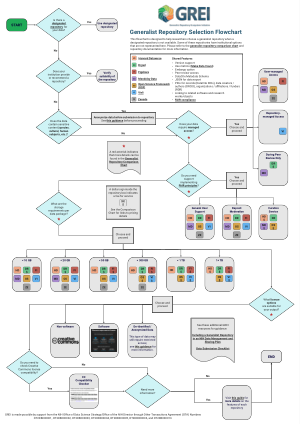
Generalist Repository Selection Flowchart
artwork · 2026-02-24
access controls
"Does your data require managed access?"p.1
cost transparency
"A dollar sign inside the repository box indicates a fee for service See the Comparison Chart for links to pricing details"p.1
endorsement
"Is there a designated repository for your data?"p.1
"Does your institution provide or recommend a repository?"p.1
licensing and usage conditions
"What license options are suitable for your output?"p.1
Global Core Biodata Resources: Concept and Selection Process
journalArticle · 2022-12-21
data usage metrics
"2a. Data resource usage quantitative data Describes usage of the biodata resource over time, including access via a web browser in terms of number of visits/hits per month, unique IP addresses (which"p.12
persistent identifiers and citations
"3a. Identifier use Describes the system used to generate and implement persistent and unique identifiers, with identifier resolution services/mechanisms employed, if relevant."p.13
preservation
"Data preservation Describes the planning by the biodata resource for data preservation in the long term."p.13
sustainability
"Describes funding secured by the biodata resource over the previous five years, current funding, and future committed funding."p.13
training resources
"training materials/opportunities"p.13
versioning
"versioning and/or evidence trails for modifications to datasets or data/metadata statements"p.13
HEAL-compliant Repository Selection Guide
webpage
access controls
"Repositories containing sensitive information from human subjects must ensure appropriate access controls to honor consent agreements between investigators and study subjects and prevent data misuse."p.5
data use compliance
"Some repository policies also prohibit data from being pulled into third-party workspaces owned by an organization or institute beyond those listed on the data use agreement signed by a researcher and"p.5
preservation
"Persistence We define repository persistence as being reliably present and maintained long-term (ten years or more)."p.3
sustainability
"We define repository persistence as being reliably present and maintained long-term (ten years or more)."p.3
How to (Easily) Extend the FAIRness of Existing Repositories
journalArticle · 2024/08/13
curation
"Providing a moderation space within a platform where curation experts can check, verify, and approve content, README files for context, and metadata completion is suggested to aid interoperability bet"p.196
data accessibility
"Accessibility as it relates to FAIR takes technological protocols like HTTP(S), SMTP and FTP into account. Indeed, these are a low bar to ensure content is free and open. These accessibility guideline"p.196
disability inclusive accessibility
"Accessibility as it relates to FAIR takes technological protocols like HTTP(S), SMTP and FTP into account. Indeed, these are a low bar to ensure content is free and open. These accessibility guideline"p.196
documented APIs
"One of the key tenets of the FAIR principles is ensuring published data is understandable for both humans and machines (in this case, query-able programmatically), and the best way to ensure this publ"p.195
licensing and usage conditions
"Clearly defined licenses for both metadata and files are of utmost importance when it concerns legal rights of reuse of content. These must be human and machine readable and assigned to both the actua"p.196
machine-actionability
"One of the key tenets of the FAIR principles is ensuring published data is understandable for both humans and machines (in this case, query-able programmatically), and the best way to ensure this publ"p.195
"Clearly defined licenses for both metadata and files are of utmost importance when it concerns legal rights of reuse of content. These must be human and machine readable and assigned to both the actua"p.196
persistent identifiers and citations
"Exposing persistent identifiers (PIDs) as uniform resource identifiers (URIs) is the first recommendation."p.195
"Preservation workflows ensure that PIDs should always point to the research output in question, along with the associated metadata. However, as data file sizes grow, repositories must find a way to su"p.196
preservation
"Preservation workflows ensure that PIDs should always point to the research output in question, along with the associated metadata. However, as data file sizes grow, repositories must find a way to su"p.196
sustainability
"Preservation workflows ensure that PIDs should always point to the research output in question, along with the associated metadata. However, as data file sizes grow, repositories must find a way to su"p.196
Improving Opportunities for New Value of Open Data: Assessing and Certifying Research Data Repositories
journalArticle · 2021-01-01
certification
"Knowing whether a candidate data repository has been independently assessed to be appropriately managing data for future use also can help data producers determine where to submit their data. Identify"p.4
cost transparency
"costs of deposit and preservation,"p.3
credible reputation
"reputation"p.3
curation
"From this perspective, the FAIR Principles also are relevant to the curation practices that enable future use and should be considered as integral when providing capabilities for data curation."p.5
data accessibility
"discovery and access capabilities,"p.3
data discovery
"discovery and access capabilities,"p.3
designated community
"disciplines and communities served,"p.3
"Improved channels of communication among such stakeholders, across repositories, disciplines, and international borders can help to identify common needs for improving the certification of data reposi"p.6
sustainability
"sustainability,"p.3
training resources
"user support services"p.3
transparent repository governance
"data policies,"p.3
user support
"Improved channels of communication among such stakeholders, across repositories, disciplines, and international borders can help to identify common needs for improving the certification of data reposi"p.6
Indigenous Metadata Bundle Communique
report · 2024
Indigenous data governance
"Lands and waters refers to physical lands and waters including longitude and latitude data, microbial data as well as the Indigenous concept of all the environmental, ethical, and spiritual relationsh"p.3
"Protocols refer to existing Indigenous laws, expectations, and preferences for the care, management, and/or stewardship, for data, including current and future responsibilities. As formal protocols, a"p.3
"Governance includes a range of Indigenous community-determined actions that inform how data are permissioned (including access rights, use rights and editing rights) and defined, and once created how "p.3
Traditional Knowledge labels
"Local Contexts Notices and Labels do two things. The Notices allow for institutions and researchers to disclose the persistence of Indigenous rights and interests in data. The Labels allow for distinc"p.3
data accessibility
"accessible"p.1
data discovery
"findable"p.1
data quality assurance
"Data Quality"p.3
persistent identifiers and citations
"Persistent Identifiers"p.3
provenance
"Provenance information provides the key connection to data origins and defines the relationships that continue to be important to the future use of data. Following the IEEE Recommended Practice on the"p.3
Informed Consent Contexts in a Multidisciplinary Research Data Repository
journalArticle · 2025-12-10
curation
"development of data curation procedures that are attentive to harmonisation between terms of consent and terms of use and ensure that limitations on secondary use are described clearly and precisely."p.14
data handling ethics
"implementation of policies that require depositors to include and label original terms of consent and/or ethics approvals for the deposit of human data"p.14
licensing and usage conditions
"for repositories with self-deposit or minimal-mediation policies, the development of deposit guidelines outlining how depositors should describe conditions of access and use of data, including proced"p.14
"application of metadata schema describing terms of consent for secondary use and the reuse limitations imposed by those terms"p.14
standardized metadata
"application of metadata schema describing terms of consent for secondary use and the reuse limitations imposed by those terms"p.14
Institutional Repositories as a Data Trust Infrastructure
conferencePaper · 2019
access controls
"Controlled Access – licensing, flexible IP restrictions, managed embargoes and negotiated access restrictions. *"p.1
"access controls"p.1
"Provenance – logging events and activities of users and data holdings*"p.2
curation
"Quality assurance - Editorial oversight and expert scrutiny of data and metadata"p.2
data accessibility
"access"p.1
data discovery
"discovery"p.1
data quality assurance
"Quality assurance - Editorial oversight and expert scrutiny of data and metadata"p.2
data transformation capabilities
"Support for a wide variety of data formats with automatic transformations"p.1
data usage metrics
"Bespoke functionality - shared, community evaluated “apps” to create new processing, analysis and visualization capabilities such as showing bibliometric and social citations from external web servic"p.2
"Analytics to audit the use of each item and assess its value*"p.2
data viewer
"Bespoke functionality - shared, community evaluated “apps” to create new processing, analysis and visualization capabilities such as showing bibliometric and social citations from external web servic"p.2
designated community
"Resource annotation, commentary and user interaction to support stakeholder engagement"p.2
high-volume data storage capacity
"cloud storage options"p.1
integrated deposit workflows
"Interoperability with existing portfolio of institutional software platforms and bureaucratic processes"p.2
legal compliance
"Accountability and Compliance – management reporting for external stakeholders*"p.2
licensing and usage conditions
"Controlled Access – licensing, flexible IP restrictions, managed embargoes and negotiated access restrictions. *"p.1
open format
"Support for a wide variety of data formats with automatic transformations"p.1
persistent identifiers and citations
"Identity management at local (corporate accounts) and global (ORCID) level. *"p.1
"Bespoke functionality - shared, community evaluated “apps” to create new processing, analysis and visualization capabilities such as showing bibliometric and social citations from external web servic"p.2
provenance
"provenance"p.1
"Provenance – logging events and activities of users and data holdings*"p.2
standardized metadata
"Resource discovery through classification schemas as well as indexing of metadata and data. Also supported are interoperability formats and services such as RSS, embedded shares and OAI-PMH data harv"p.2
transparent repository governance
"Accountability and Compliance – management reporting for external stakeholders*"p.2
user authentication
"Identity management at local (corporate accounts) and global (ORCID) level. *"p.1
IODE Quality Management Framework for National Oceanographic Data Centres and Associate Data Units
journalArticle
continuity plans
"Commitment to return data holdings to originators, or lodging with an alternative repository, if the NODC/ADU becomes unsustainable A long-term stewardship plan should be available including: • A sta"p.23
cybersecurity
"Security Policy outlining the infrastructure for protection of the facility and its data, products and services"p.24
data discovery
"Maintain a discovery metadata catalogue The NODC/ADU shall maintain an online metadata discovery catalogue that provides a description of their data and services."p.24
data quality assurance
"The NODC/ADU shall establish and maintain a quality management system and document: a) the scope of the quality management system b) procedures established by the quality management system c) a descri"p.23
data usage metrics
"Statistics/metrics indicating data usage"p.24
licensing and usage conditions
"Licensing arrangements"p.24
staff expertise
"Proof of expertise and reputation in the area of ocean and marine data management The NODC/ADU shall describe the range and length of expertise of both the organization and their staff."p.23
Long Tail of Data
report · 2016-09-15
data discovery
"Discoverability is another one and one important strand of work is to increase discoverability in diverse repositories"p.9
nestor materials 17: Explanatory notes on the nestor Seal for Trustworthy Digital Archives, Version 2.2
document
access controls
"The required administrative metadata must be systematically collected so that only permissible measures (e.g. multiple storage, migration and access for authorised users) can be performed."p.51
certification
"Implemented, 10 points"p.22
"The nestor Seal procedure follows DIN standard 31644. 8 Containing 34 criteria, it makes use of a plausibility-checked, evidence-based and expert-reviewed self-assessment. It is therefore more labour-"p.7
"The CoreTrustSeal5 provides expert-reviewed self-assessment based on 16 criteria. An audit in the form of an on-site inspection by external experts is offered by the PTAB 6 on the basis of ISO standar"p.7
"The extended self-assessment process for digital archives developed and offered by nestor on the basis of the DIN 31644 standard offers digital archives a harmonised and practical method of checking w"p.6
"In this Memorandum nestor, the "Data Seal of Approval" and the "Repositories Audit and Certification" agreed upon three evaluation and certification levels2."p.6
continuity plans
"The digital archive is in possession of a plan which ensures continuation of the preservation tasks even beyond the archive's own existence. The digital archive should have made contingency plans."p.28
cost transparency
"The digital archive openly declares its conditions of use and any costs which may arise, listing these in a transparent manner."p.19
"The digital archive should first have identified all its current and prospective cost units and documented these in a cost model."p.24
cybersecurity
"The purpose of the IT infrastructure is to implement the technical and security requirements specified in C13-26. Accordingly, the infrastructure should be described in abstract terms."p.52
"The result should be a comprehensive and coherent security concept, including all planned measures."p.53
"Every trustworthy digital archive must implement suitable measures to protect its own integrity and that of its archive assets to ensure that the assets remain intact and to fulfil its legal or contra"p.53
"The IT infrastructure should realise the specifications for handling the information objects and representations at the technology and security levels."p.43
data accessibility
"The digital archive ensures that authorised users in the designated communities can access the representations. This includes appropriate search possibilities."p.19
data discovery
"Access also includes offering search possibilities to find the archived information and also information on the terms of use and restrictions."p.19
data use compliance
"It is important for the digital archive to know exactly which regulations apply to it and to ensure that either legal regulations or individual contracts exist for all relevant areas."p.22
"The digital archive monitors and documents conformity with relevant regulations concerning the ingest, archiving and use of digital objects. These include: data protection, protection of the rights of"p.17
"The internal administration and the access to archived digital objects must be conducted on an organised technical basis for legal or contractual reasons."p.42
licensing and usage conditions
"The digital archive openly declares its conditions of use and any costs which may arise, listing these in a transparent manner."p.19
"The nature and scope of the delivery is regulated, as are the digital archive's archival obligations, the conditions of use and, where applicable, the costs."p.22
"Use of the representations may be restricted for legal or contractual reasons."p.51
preservation
"The digital archive assumes responsibility for the long-term preservation of the information objects on the basis of legal requirements or its own objectives. Long-term preservation means ensuring the"p.16
"The digital archive should conduct strategic planning as a means of preserving the digital objects entrusted to it. This should include imminent or expected tasks and specify the deadlines by which th"p.27
"Technical preservation measures are undertaken to ensure the interpretability of the archival information packages."p.43
"During the archiving process the transferred representations must either repeatedly be transformed into new representations or be expanded to include emulators (migration or emulation strategy)."p.50
"The DIN standard defines a digital archive as "an organisation (consisting of people and technical systems) which has assumed responsibility for the long-term preservation and long-term availability o"p.7
"The digital archive logs the preservation measures and any changes to the representations."p.41
provenance
"The digital archive logs the preservation measures and any changes to the representations."p.50
"These changes have a direct impact upon the integrity and authenticity of the archived representations and information objects and must be systematically and permanently logged to ensure that all chan"p.50
risk management
"Which damage scenarios based on malicious actions, human error or technical failure do you regard as posing a particular threat to the preservation of the information objects and representations? How "p.53
"Such measures should be based on identification of sections of the archive which are worthy of protection, an analysis of any potential threat to specific archives and a risk assessment of the damage "p.53
staff expertise
"Sufficient numbers of appropriately qualified staff are available. Updated job descriptions exist which set out the required qualifications of the digital archive personnel and contain an organisation"p.25
standardized metadata
"These include both standardised (e.g. DC or EAD) and customised metadata schemata. The names of the metadata elements, the significance of the content and any mandatory fields should be determined."p.47
"The scope, structure and content of the descriptive metadata are defined. They depend on the goals of the digital archive, its designated communities and the object types."p.47
"The structure of the representations must be adequately described so that the information objects can be reconstructed and used."p.48
"Which metadata are needed depends e.g. on the type of object, on the chosen preservation strategy and on the objectives and designated communities of the particular archive. The PREMIS concept contain"p.49
"The technical metadata are defined to ensure interpretability, integrity and authenticity and to manage the preservation measures."p.49
"The digital archive has defined its administrative metadata in order to render the administration and use of the information objects and their representations transparent."p.51
"The PREMIS concept contains a common standard for logging preservation measures."p.41
sustainability
"Valid budget planning exists, as does a long-term funding plan for the digital archive."p.24
"In addition the funding plan should also include long-term forecasts which contain future projections for funding requirements of the digital archive."p.18
curation
"Criteria have been defined for the selection of information objects and their representations in the digital archive. The framework is provided by legal obligations, the institution's or company's bas"p.11
multilingual support
"The self-assessment and the documents submitted or referenced must be in German or English."p.9
versioning
"A digital archive should use internal identifiers to manage the information objects and their representations and, where applicable, their parts and relationships (part/totality, different variants, v"p.37
Norms of data sharing in biological sciences: The roles of metadata, data repository, and journal and funding requirements
journalArticle · Apr 2016 2025-11-15
tagged as sustainability

OGC Standards | WMS, WFS, GeoPackage & 80+ Open Geospatial Specs
document
cybersecurity
"Web Services Security"p.1
data accessibility
"The functional capabilities of the Web Service Standards are now available as more modern web APIs. Implementers are encouraged to use these newer OGC API Standards."p.1
data discovery
"They are organized by functional area (e.g., data discovery, organization)."p.1
"Standards for searching and finding geospatial resources."p.1
machine-actionability
"Standards that take advantage of modern web development practices such as JSON, REST, and OpenAPI."p.1
open format
"Standards that provide domain specific rules to organize geospatial information."p.1
"Standards that provide general rules to organize geospatial information, typically sent by a service provider or produced by an application."p.1
"OGC Standards are internationally recognized specifications that let different systems exchange information seamlessly."p.1
semantic interoperability
"GeoSPARQL – A Geographic Query Language for RDF Data"p.1
"Semantic Sensor Network Ontology"p.1
standardized metadata
"EO Dataset Metadata GeoJSON(-LD)"p.1
Omics Data Publishing to International Repositories from Australia
report · 2023-11-17
data accessibility
"In accordance with the Bermuda and Fort Lauderdale 67 agreements and the more recent Toronto Statement , which provide guidelines for scientific data sharing, 8 life science researchers are expecte"p.4
data discovery
"In accordance with the Bermuda and Fort Lauderdale 67 agreements and the more recent Toronto Statement , which provide guidelines for scientific data sharing, 8 life science researchers are expecte"p.4
user documentation
"Most researchers we interviewed felt that the documentation provided by many repositories could be more user friendly. The information is perceived to be presented in convoluted formats and the user i"p.15
Reference Model for an Open Archival Information System (OAIS)
document
access controls
"Security information that includes user names and any passwords or other mechanisms needed to authenticate the identity and privileges of Archive users."p.103
"The Archive chooses to store this information as two AIPs: one that contains public information and the other that contains sensitive information. This makes it easier for the Archive to manage access"p.106
"User Authentication and Access Management for global users. If an OAIS has a policy that restricts the access to some of its AIPs or charges for the dissemination of some Information Packages, there i"p.135
"Any Information Packages derived from Content Information should respect the access rights associated with that Content Information; when Information from multiple Content Information Objects has been"p.149
"Access controls may also need to be put in place if required."p.150
"Access Rights Information: The information that identifies the access restrictions pertaining to the Content Data Object, including the legal framework, licensing terms, and access control."p.20
"Access Rights Information provide the terms of access, including preservation, distribution, and usage of the Content Data Object. For example, it would contain the statements to grant the OAIS permis"p.35
"Some AIPs may have restricted access and therefore may only be disseminated to Consumers who meet access restrictions. The OAIS should have published policies on access and restrictions so that the ri"p.49
"Access functions include communicating with Consumers to receive requests, applying controls to limit access to specially protected information, coordinating the execution of requests to successful co"p.52
"Access control service prevents the unauthorized use of information system resources. This service also prevents the use of a resource in an unauthorized way. This service may be applied to various as"p.54
"The Physical Access Control function provides mechanisms to restrict or allow physical access (doors, locks, guards) to elements of the Archive, as determined by Archive policies which it receives fro"p.62
"This function will determine if resources are available to perform a request, assure that the user is authorized to access and receive the requested items, and notify the Consumer that a request has b"p.67
"Access Rights Information identifies the access restrictions pertaining to the Content Data Object, including the legal framework, licensing terms, and access control. It contains the access and distr"p.85
certification
"Oversight and monitoring of the OAIS providing the service could be simplified by requiring the OAIS be certified as a Trustworthy Digital Repository in accordance with the metrics specified by CCSDS "p.139
"This should include all appropriate security measures such as physical access, backup and recovery processes, periodic integrity checking, and other measures, for example, measures from ISO/IEC 27040 "p.149
continuity plans
"The Content Data Object of the Content Information being preserved may be kept by the Archive but may be changed; or kept by the Archive unchanged; or not kept by the Archive, but instead handed on to"p.110
"If an OAIS cannot for some reason continue to preserve Content Information that is to be preserved, then that OAIS must hand over that Content Information to another OAIS. However, in order for the su"p.128
"Although some facilities holding information may themselves be temporary, some or all of their information may need to be preserved indefinitely. Such facilities need to be active participants in the "p.13
"Follow documented policies and procedures which ensure that the information is preserved against all reasonable contingencies, including the demise of the Archive, ensuring that it is never deleted un"p.149
"In the case of the demise of the Archive the identity of any successor organization should be verified and transmission of holdings to that organization should be carried out using tamper-proof techni"p.150
"Succession Plan: The plan of how and when the management, ownership and/or control of the OAIS holdings will be transferred to a subsequent OAIS in order to ensure the continued effective preservation"p.27
"The Archive should have a formal Succession Plan, contingency plans, and/or escrow arrangements in place in case the Archive ceases to operate or the governing or funding institution substantially cha"p.48
"The Disaster Recovery function provides a mechanism for duplicating the digital contents of the Archive collection and, for example, storing the duplicate in a physically separate facility. This funct"p.58
"It will develop disaster recovery policies."p.63
curation
"In addition, the Ingest Functional Entity will classify incoming information objects and determine in what existing collection or collections, if any, each object belongs and will update the appropria"p.107
"The Check Submission must verify that there is adequate Representation Information and PDI to ensure that the Content Information is understandable and independently usable to the Designated Community"p.63
cybersecurity
"Security information that includes user names and any passwords or other mechanisms needed to authenticate the identity and privileges of Archive users."p.103
"ANNEX F SECURITY CONSIDERATIONS (INFORMATIVE)"p.11
"User credential passing where the specific remote user can be authenticated by any of the Federation OAISes and the global node simply acts as an intermediary to carry the authentication dialog."p.136
"This should include all appropriate security measures such as physical access, backup and recovery processes, periodic integrity checking, and other measures, for example, measures from ISO/IEC 27040 "p.149
"The identity of the information Producer should be validated where appropriate, not least to ensure that the evidence for Authenticity of the information can be relied upon. Communications between the"p.149
"Attacks on an Archive such as denial of service attacks may raise security concerns which would need to be addressed."p.150
"Common Services: The supporting services such as inter-process communication, name services, temporary storage allocation, exception handling, security, and directory services necessary to support the"p.21
"Security services provide capabilities and mechanisms to protect sensitive information and treatments in the information system. The appropriate level of protection is determined based upon the value "p.53
"Identification/authentication service confirms the identities of requesters for use of information system resources. In addition, authentication can apply to providers of data. The authentication serv"p.54
"the archive can independently provide account services or may coordinate with the organization's single sign-on service to ensure appropriate access to the archive."p.63
"It will also determine security policies for the contents of the Archive based, for example, upon statutory requirements and legal agreements. Legislation will be different between countries and will "p.63
data accessibility
"Once the Consumer identifies the OAIS holdings to acquire, the Consumer uses an OAIS-supplied Ordering Aid to develop an Order Agreement to acquire the data. The Consumer produces a logical view of th"p.108
"The organization has accepted the responsibility to preserve information and make it available for a Designated Community."p.12
"Two OAIS Archives that have similar Designated Communities have decided to federate to allow Consumers to locate AIPs of interest from either OAIS with a single Search Session. The Common Catalog is t"p.133
"Access Functional Entity: The OAIS functional entity that provides the services and functions that support Consumers in determining the existence, description, location and availability of information"p.20
"In response to a request, the OAIS provides one or more Dissemination Information Packages (DIPs) to a Consumer. The DIP(s) are derived from one or more AIPs. For dissemination purposes, the DIP's Pac"p.36
"By definition, an OAIS makes the Content Information in its AIPs visible and available to its Designated Communities. Multiple views of its holdings, supported by various Access Aids that may cut acro"p.49
"The Coordinate Access Activities function provides one or more interfaces to the information holdings of the Archive. Three categories of Consumer requests are distinguished, responses to which are de"p.67
"In response to an Order, the OAIS provides all or a part of an AIP to a Consumer in the form of a Dissemination Information Package (DIP). The DIP may also include collections of AIPs, and it may or m"p.90
"The Package Description must contain one Associated Description that supplies data for a Retrieval Aid that allows authorized users to retrieve the Content Information and PDI described by the Package"p.93
data discovery
"Another important benefit of the Collection Descriptions is the ability to define new Access Collections. An Access Collection may be based on new data mining results or it may reflect current phenome"p.101
"The OAIS may have to spend significant time and effort developing Associated Descriptions and Finding Aids such as catalogs that will aid the Consumer in locating AIPs or AICs of interest."p.108
"When a Consumer wishes to use the data within the OAIS, a Finding Aid may be used to locate information of interest. Finding Aids present Consumers with the logical view of the OAIS holdings so the Co"p.108
"Users of multiple OAIS Archives may have reasons to wish for some uniformity or cooperation among them. For example, Consumers of several Archives may wish to have: common Finding Aids to aid in locat"p.129
"In addition to the local community, there exists a global community which has interests in the holdings of several OAIS Archives and has influenced those Archives to provide access to their holdings v"p.133
"Access Functional Entity: The OAIS functional entity that provides the services and functions that support Consumers in determining the existence, description, location and availability of information"p.20
"Finding Aid: A type of Access Aid that allows a user to search for and identify Archival Information Packages of interest."p.23
"The Descriptive Information is that information which is used to discover which package has the Data Object of interest. Depending on the setting, this may be no more than a descriptive title of the I"p.35
"During this Search Session, the Consumer will use the OAIS Finding Aids that operate on Descriptive Information, or in some cases on the AIPs themselves, to identify and investigate potential holdings"p.41
"The Access Functional Entity provides the services and functions that support Consumers in determining the existence, description, location and availability of information stored in the OAIS, and allo"p.52
"The OAIS must provide adequate features to allow Consumers to locate information of potential interest, analyze that information, and order desired information. This is accomplished through a speciali"p.87
"A Finding Aid is an Access Aid that assists the Consumer in locating information of interest. A single AIP may have a number of Associated Descriptions that describe the Content Information using diff"p.93
"An important type of Access Aid is the Finding Aid, which assists the Consumer in locating information of interest. A single AIU may have a number of Associated Descriptions that describe the Content "p.97
data handling ethics
"Copyright implications, intellectual property and other legal restrictions on use: An Archive must honor all applicable legal restrictions. Issues often arise when an OAIS acquires materials that are "p.45
data quality assurance
"Ingest Functional Entity: The OAIS functional entity that provides the services and functions to accept Submission Information Packages from Producers (or from internal elements under Administration c"p.24
"A Submission Agreement also includes, or references, the procedures and protocols by which an OAIS will either verify the arrival and completeness of a Data Submission Session with the Producer or que"p.40
"The Ingest Functional Entity provides the services and functions to accept Submission Information Packages (SIPs) from Producers, including quality assurance and prepare Archival Information Packages "p.55
"Audit methods potentially include sampling, periodic review, and peer review. A submission report is provided to Ingest."p.63
"The Check Submission process must verify that the quality of the data meets the requirements of the Archive. It should also ensure that it meets the requirements of the outside committee if one is use"p.63
data usage metrics
"Statistical information needed by Archive administration and Management to determine future policies and performance tuning for more effective Archive operation. Examples of these statistics include t"p.103
data use compliance
"Security considerations for any agreements with rights holders which may be necessary should be covered by normal business processes. Any restrictions which the original rights holder places on what t"p.149
"It contains the access and distribution conditions stated within the Submission Agreement, related to both preservation (by the OAIS) and final usage (by the Consumer). It also includes the specificat"p.20
"Access Rights Information provide the terms of access, including preservation, distribution, and usage of the Content Data Object. For example, it would contain the statements to grant the OAIS permis"p.35
"The Consumers must also be informed of restrictions, if any, arising from the Access Rights Information associated with the Information and must agree to abide by those restrictions. Such restrictions"p.41
"Inserting DRM information and filtering the personal data to ensure consistency with the user rights also come under this type of operation."p.68
free access
"In such cases an OAIS will for example have a general pricing policy which could include free products."p.42
licensing and usage conditions
"Any restrictions which the original rights holder places on what the archive preserves should also be respected over time and adequate security measures should be put in place no matter what preservat"p.149
"Access Rights Information: The information that identifies the access restrictions pertaining to the Content Data Object, including the legal framework, licensing terms, and access control. It contain"p.20
"Access Rights Information provide the terms of access, including preservation, distribution, and usage of the Content Data Object. For example, it would contain the statements to grant the OAIS permis"p.35
"The Order Agreement will also specify other needed information such as delivery information (e.g., name or mailing address), rights information (e.g., usage restrictions, authorized Consumers, or lice"p.41
"If instead the OAIS is acquiring the Content Information or PDI from any other Producer or entity, the OAIS should ensure that there is a legally valid transfer agreement that either transfers ownersh"p.44
"It will also determine security policies for the contents of the Archive based, for example, upon statutory requirements and legal agreements."p.63
"Access Rights Information examples include: Legal framework(s), Licensing offers, Specifications for rights enforcement measures applied at dissemination time, Permission grants for preservation and f"p.85
"Access Rights Information identifies the access restrictions pertaining to the Content Data Object, including the legal framework, licensing terms, and access control. It contains the access and distr"p.85
multilingual support
"Another example is a dictionary to facilitate the translation of a text in one language to one which is understandable by a member of the Designated Community."p.122
open format
"This is most easily accomplished when the Representation Information objects are expressed in forms that are easily understandable, such as text descriptions that use widely supported standards such a"p.77
"If the word processing format is proprietary, and if adequate Representation Information cannot be acquired which will at the least allow simply viewing, to ensure its Long Term Preservation it may be"p.83
preservation
"Despite the efforts of an OAIS to make information it holds be relevant for the long-term, for example, making use of standardized data formats that are expected to be used for a time, it is inevitabl"p.110
"Digital Migration is defined to be the transfer of digital information, while intending to preserve it, within the OAIS. It is distinguished from transfers in general by three attributes: a focus on t"p.111
"The information being maintained has been deemed to need Long Term Preservation, even if the OAIS itself is not permanent. Long Term is long enough to be concerned with the impacts of changing technol"p.12
"The organization has accepted the responsibility to preserve information and make it available for a Designated Community."p.12
"For the case of interest to preservation it may be difficult or impossible to secure the necessary explicit Structure Representation Information and Semantic Representation Information for a CDO. In t"p.123
"The OAIS response to preserving an Access Software application execution service would likely depend, in part, on whether or not it had the source code for the application. If the OAIS had the source "p.125
"When emulations are developed to support Long Term Preservation, their deployment is a logical extension of the Representation Information employed by the Access Software they support."p.127
"Sufficient control includes control of the bits, and would imply adequate security processes for personnel and systems."p.149
"Follow documented policies and procedures which ensure that the information is preserved against all reasonable contingencies, including the demise of the Archive, ensuring that it is never deleted un"p.149
"Long Term Preservation: The act of maintaining information, Independently Understandable by a Designated Community, and with evidence supporting its Authenticity, over the Long Term."p.24
"A major purpose of this Reference Model is to facilitate a much wider understanding of what is required to preserve and access information for the Long Term. To avoid confusion with simple 'bit storag"p.29
"As a practical matter, software, some of which may itself be Representation Information, is used to access the Information Object, and it will incorporate some understanding of the network of Represen"p.33
"The Preservation Planning Functional Entity provides the services and functions for monitoring the environment of the OAIS, and which provides recommendations and preservation plans to ensure that the"p.51
"The Archival Storage Functional Entity provides the services and functions for the storage, maintenance and retrieval of AIPs. Archival Storage functions include receiving AIPs from Ingest and adding "p.57
"The Develop Packaging Designs and Preservation Plans function develops new Information Package designs such as AIP/SIP templates and detailed preservation plans and prototype software to implement Adm"p.65
"the primary goal of an OAIS is to preserve information for a Designated Community over an indefinite period of time. In order to preserve this information an OAIS must store significantly more than th"p.71
"Indefinite Long Term information preservation requires a full and understandable description of the Representation Information."p.81
"In addition to Content Information, the Archival Information Package must include information that will support the trust in, the access to and context of the Content Data Object over an indefinite pe"p.84
"The Preservation Description Information requirements in an AIP are much more stringent than the requirements for Preservation Description Information in the general Information Package. While no PDI "p.91
"The AIP is defined to provide a concise way of referring to a set of information that has, in principle, all the qualities needed for permanent, or indefinite, Long Term Preservation of a designated I"p.91
provenance
"Preservation process history information that tracks the migrations of AIPs, including media replacements and AIP transformations, whether the Representation Information has been changed by the Archiv"p.103
"If a Transformation is performed, evidence that the Transformational Information Properties were verified after the Transformation should be captured as part of the Provenance Information for the AIP."p.117
"It is also expected that the OAIS will track the existence of these events, including the verifications made, as a part of its larger operational provenance as this will lend additional evidence conce"p.120
"The supplementary information identified in 2.5 may be relevant as part of Provenance and may be handed over also."p.128
"Ways to be more sure of the authenticity of information, by knowing its provenance and being sure that it has not been altered, will help to counter these threats"p.14
"In order for the primary OAIS to get all Provenance Information, each supporting OAIS will, of course need to handle Provenance Information for the AIPs which are being held for the primary OAIS and m"p.140
"Security considerations here include respecting restrictions imposed by the original rights holders and appropriate security and Authenticity of the content of the components of the Archival Informati"p.149
"In the case of the demise of the Archive the identity of any successor organization should be verified and transmission of holdings to that organization should be carried out using tamper-proof techni"p.150
"Provenance Information: The information that documents the history of the Content Data Object. This information tells the origin or source of the Content Data Object, any changes that may have taken p"p.26
"Provenance Information describes the source of the Content Data Object, who has had custody of it since its origination, and its history (including processing history)."p.34
"It is important that these changes are documented as part of the Provenance Information of the object so the object is traceable to the original object submitted to the Archive by the Producer. It is "p.55
"Provenance Information documents the history of the Content Data Object. This tells the origin or source of the Content Data Object, its Information Properties to be preserved (Transformational Inform"p.84
"The PDI provides further information about the AIC such as Provenance Information on when and why it was created, Context Information showing related AICs, the desired level of security, Fixity Inform"p.99
risk management
"Digital Migrations may be time consuming, costly, and expose the OAIS to greatly increased probabilities of information loss. Therefore, an OAIS will need to study Digital Migration issues and plan ap"p.112
"Based on the models and concepts above, it is possible to identify four primary Digital Migration types. The primary types, ordered by increasing risk of information loss, are:"p.114
"An Archive could distribute its Archival Storage hardware in various geographic locations. In this example, such distribution would allow the Archive to maintain copies of its preserved data in ways t"p.138
"The rapid obsolescence of digital technologies creates considerable technical dangers, particularly a much greater risk than in the past of losing the possibility of restoring, rendering or interpreti"p.14
"Risk analysis reports"p.141
"Management will generally conduct some regular review process to evaluate the OAIS performance and progress toward Long Term goals, and assess the risks to which the OAIS and its holdings are exposed."p.39
"Preservation Planning functions include evaluating the contents of the Archive and periodically recommending archival information updates, recommending the migration of current Archive holdings, devel"p.52
"It will have to face risks from unforeseen events (unplanned down time due to network outage, software bugs, hardware failure, human error, disk crash, etc.) and make the appropriate decisions to mini"p.62
"Risk management is a suitable methodology to provide balance between needs and means, and between immediate activity imperatives and Long Term objectives of the preservation mission. Risk management c"p.65
semantic interoperability
"Another example is a dictionary to facilitate the translation of a text in one language to one which is understandable by a member of the Designated Community."p.122
"This type of additional required information is referred to as the Semantic Representation Information. When dealing with scientific data, for example, the information in the Semantic Representation I"p.74
staff expertise
"If the Archive does not have this level of expertise in-house, it may have outside community representatives review the information for Long Term understandability. Otherwise some of the information m"p.47
standardized metadata
"Global access is accomplished by the export of a standard-format Associated Description to a global site. The global site independently manages a set of descriptors from many Archives and has Finding "p.134
"Descriptive Information: An Information Object which is a set of information, consisting primarily of Package Descriptions, which is provided to Data Management to support the finding, ordering, and r"p.22
"Package Description: The information intended for use by Access Aids. It is a type of Information Object."p.25
"The Generate Descriptive Information function extracts Descriptive Information from the AIPs and collects Descriptive Information from other sources to provide to Coordinate Updates, and ultimately Da"p.56
"The standards include format standards, documentation standards and the procedures to be followed during the Ingest process."p.62
"The standards include format standards, metadata standards and documentation standards. It applies these standards to preservation requirements and provides AIP and SIP template designs to Administrat"p.66
"The Descriptive Information is generally derived from the Package Description, which is itself derived from the Content Information and PDI. The Descriptive Information can be viewed as an index to en"p.87
sustainability
"Improved Cost-Effectiveness: The rapid pace of hardware (e.g., disk/tape drives) and software evolution provides greatly increasing storage capacities and transfer bandwidths at reducing costs. It als"p.111
"The information being maintained has been deemed to need Long Term Preservation, even if the OAIS itself is not permanent. Long Term is long enough to be concerned with the impacts of changing technol"p.12
"The Preservation of Federation Access to AIPs when an OAIS terminates operations. Unfortunately, many Archives will close while their holdings still are of value to the Federation community. The feder"p.135
"Management is often the primary source of funding for an OAIS and therefore should agree the budget for the Archive's activities and may provide guidelines for resource utilization (personnel, equipme"p.39
REPOSITORIES: Key Infrastructure For Μaintaining European Research Εxcellence
document · MAR 12, 2025
AI-readiness
"Structure metadata and repositories for AI-driven research, discovery, and automation. • Adopt machine-readable metadata, linked data practices, and text/data mining capabilities to ensure repositor"p.6
"Powered by AI-ready infrastructure"p.6
cybersecurity
"Implement strong digital preservation and security measures • Safeguard research outputs from cyber incidents, data loss, and technological obsolescence. • Ensure regular backups, infrastructure mon"p.6
"R esilient & Secure against cyber threats and technological changes"p.6
data accessibility
"Structure metadata and repositories for AI-driven research, discovery, and automation. • Adopt machine-readable metadata, linked data practices, and text/data mining capabilities to ensure repositor"p.6
documented APIs
"Adopt open standards, persistent identifiers, and API-driven integrations. • Ensure repositories comply with FAIR principles by using standardized metadata, and other persistent identifiers. • Enable"p.6
endorsement
"Aligned with institutional research policies"p.6
federated systems and networks
"Strengthen national, regional, and international collaboration. • Actively participate in repository networks and global initiatives to enhance visibility, share best practices, and align with evolv"p.6
"Connected to national and international repository networks"p.6
funder information
"Adopt open standards, persistent identifiers, and API-driven integrations. • Ensure repositories comply with FAIR principles by using standardized metadata, and other persistent identifiers. • Enable"p.6
machine-actionability
"Structure metadata and repositories for AI-driven research, discovery, and automation. • Adopt machine-readable metadata, linked data practices, and text/data mining capabilities to ensure repositor"p.6
persistent identifiers and citations
"Adopt open standards, persistent identifiers, and API-driven integrations. • Ensure repositories comply with FAIR principles by using standardized metadata, and other persistent identifiers. • Enable"p.6
preservation
"Implement strong digital preservation and security measures • Safeguard research outputs from cyber incidents, data loss, and technological obsolescence. • Ensure regular backups, infrastructure mon"p.6
resource linking and relationships
"Structure metadata and repositories for AI-driven research, discovery, and automation. • Adopt machine-readable metadata, linked data practices, and text/data mining capabilities to ensure repositor"p.6
staff expertise
"Invest in staff training and upskilling for repository management and AI-driven research. • Ensure repository managers and librarians receive ongoing training in metadata curation, research data man"p.6
"Trained professionals ensuring repository excellence"p.6
standardized metadata
"Adopt open standards, persistent identifiers, and API-driven integrations. • Ensure repositories comply with FAIR principles by using standardized metadata, and other persistent identifiers. • Enable"p.6
sustainability
"Ensure repositories are integral to research policies and funding strategies. • Do not treat repositories as isolated services but as key components of the institution’s broader open science and res"p.6
"Secure long-term investment to maintain, scale, and enhance repositories. • Treat repositories as critical research infrastructure and ensure dedicated institutional budget lines and sustainable fun"p.6
"Maintained with sustainable funding and adequately staffed"p.6
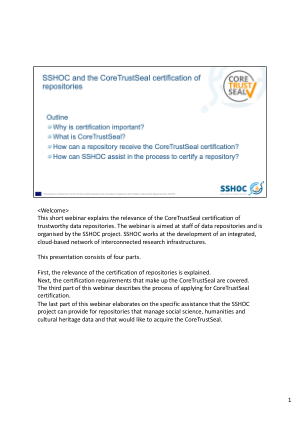
SSHOC Webinar: How to improve the quality of your repository - SSHOC and certification of repositories
presentation · 2020-04-23
tagged as certification
Study on the readiness of research data and literature repositories to facilitate compliance with the Open Science Horizon Europe MGA requirements
webpage
access controls
"potential restrictions for accessing repository content"p.19
licensing and usage conditions
"Metadata should contain information about licensing"p.20
machine-actionability
"Metadata should be machine-actionable and standardised"p.20
persistent identifiers and citations
"the capacity of the repository to assign a PID to the content"p.19
preservation
"For scholarly journals, books, and other types of published content, publishers can enrol into one or several preservation services (e.g., Portico59, CLOCKSS60) that ensure the long-term archiving of "p.19
The core of the matter: How do scientists judge trustworthiness of physical samples?
journalArticle · 2022 OCT 28
data quality assurance
"Researchers face challenges when judging a sample’s trustworthiness. In many cases, researchers procure samples from large-scale infrastructural projects comprising many components: human (e.g., profe"p.2

The RDF Data Cube Vocabulary
webpage
data accessibility
"Reference metadata describes the dataset as a whole, such as categorization of the dataset, its publisher, and a SPARQL endpoint where it can be accessed."p.1
data discovery
"Publishers of statistics often categorize their data sets into different statistical domains, such as Education, Labour, or Transportation. We encourage use of dct:subject to record such a classificat"p.1
data quality assurance
"A well-formed RDF Data Cube is an a RDF graph describing one or more instances of qb:DataSet for which each of the integrity checks defined here passes."p.1
licensing and usage conditions
"DataSets should be marked up with metadata to support discovery, presentation and processing. Dublin Core Terms [DC11] should be used for representing the key metadata annotations commonly needed for "p.1
machine-actionability
"For publishers who currently only offer static files then publishing as linked-data offers a flexible, non-proprietary, machine readable means of publication that supports an out-of-the-box web API fo"p.1
semantic interoperability
"In those cases we recommend use of SKOS, representing the individual code values using skos:Concept and the overall set of admissible values using skos:ConceptScheme or skos:Collection."p.1
"A key component of the SDMX standards package are the Content-Oriented Guidelines (COGs), a set of cross-domain concepts, code lists, and categories that support interoperability and comparability bet"p.1
standardized metadata
"DataSets should be marked up with metadata to support discovery, presentation and processing. Dublin Core Terms [DC11] should be used for representing the key metadata annotations commonly needed for "p.1
The TRUST Principles for digital repositories
presentation · 2020-05-14
data accessibility
"accessibility"p.2
data authenticity
"authenticity"p.2
preservation
"data integrity"p.2
sustainability
"Sustainability Ensuring sustainability of a TRUSTworthy repository is necessary to ensure uninterrupted access to its valuable data holdings for current and future user communities. Continued access "p.3
transparent repository governance
"transparency In order to select the most appropriate repository for a particular use case, all potential users benefit from being able to easily find and access information on the scope, target user "p.2
The W3C Data Catalog Vocabulary, Version 2: Rationale, Design Principles, and Uptake
preprint · 2023-03-15
data accessibility
"DCAT 2 adds mechanisms for including data services. Data is often served via web services. A service may provide access to more than one dataset, and it is necessary to know how to query the service A"p.13
"Distributions represent a general availability of a dataset, whose access can include different access methods (e.g., direct download, API, or through a Web Page)."p.14
data discovery
"DCAT is an RDF vocabulary designed to facilitate interoperability between data catalogs published on the Web."p.1
"Besides enabling data discovery and re-use, metadata is now also considered crucial to providing all the information necessary to reproduce an experiment—not only in order to verify the research resul"p.2
"The index for Google's Dataset Search service relies on structured description in Web pages about datasets using both Schema.org and DCAT."p.20
"Thanks to this, DCAT facilitates effective search and retrieval and permits easy scaling up of the query process either through "frictionless" aggregation of dataset descriptions and catalog records f"p.23
data quality assurance
"DCAT 2 provides guidelines for documenting the quality of resources and distributions. Consistently with the recommendations from the Data on the Web Best Practices (DWBP), the use cases ID45 and ID14"p.17
"The property dqv:hasQualityMeasurement relates resources and distributions to quality measurements (instances of dqv:QualityMeasurement) evaluated by community-defined domain-specific metrics (dqv:Met"p.18
data usage metrics
"DCAT 2 provides information required for data citation (see Req. RDSC and Issue 61). DCAT 2 provides equivalents to all the mandatory elements in DataCite."p.11
"By applying this property, DCAT 2 tracks publications that reuse or describe a specific dataset (see Req. RDSP and Issue 63)."p.12
licensing and usage conditions
"For the first case, DCAT 2 recommends the property dcterms:license to refer to canonical URIs of well-known licenses such as those defined by Creative Commons."p.9
"DCAT 2 elaborates the guidelines to handle licenses and rights (see Issue 114). Different best practices recommend providing data license and right information (e.g. DWBP [7]). However, multiple use c"p.9
machine-actionability
"It is a core building block for developing REST API aiming at creating, storing, and serving FAIR metadata (see FAIR Data Point (FDP) [55])."p.22
"DCAT gives people and machines a specific and domain-independent approach to create catalogs that express the core elements of a dataset description in a standardized way that is suitable for publicat"p.22
"RDF promotes an inherently machine-actionable approach, where each term in a metadata schema has its own identifier, which can be used to retrieve the term's semantics, and terms from distinct vocabul"p.6
multilingual support
"dcterms:language refers to the natural language used for textual metadata (i.e. titles, descriptions, etc) of a cataloged resource."p.10
open format
"However, being specifically suited for RDF dataset and linked data practices, it does not cover all the types of data required by the open and research data community (e.g., CSV, JSON)."p.21
provenance
"DCAT 2 supports complex non-binary relations. It uses qualified relations to deal with relations not covered by the above or other known properties (e.g., PROV-O properties such as prov:wasDerivedFrom"p.12
"DCAT 2 tracks the project that has generated a resource: prov:wasGeneratedBy links datasets to the projects that have generated them (Req. RPR and Issue 77)."p.12
semantic interoperability
"dcat:keyword classifies the resources using free-text keywords, while dcat:theme classifies resources with concepts taken from Knowledge Organization Systems (KOS) and possibly available as Linked Dat"p.10
"the reuse of terms from consolidated metadata vocabularies eases the interoperability promoting the adoption of cross-vocabulary modeling patterns; the minimization of ontology commitment opens to its"p.23
"DCAT 2 incorporates terms from pre-existing vocabularies where stable terms with appropriate semantics could be found. This is consistent with the Data on the Web Best Practice (DWBP) #15 "Use terms f"p.5
standardized metadata
"DCAT is an RDF vocabulary designed to facilitate interoperability between data catalogs published on the Web. Since its first release in 2014 as a W3C Recommendation, DCAT has seen a wide adoption acr"p.1
"DCAT 2 is a metadata schema that facilitates data catalogs' interoperability on the Web. DCAT gives people and machines a specific and domain-independent approach to create catalogs that express the c"p.22
"Besides, for formal standards issued by bodies like ISO and W3C, dcterms:conformsTo is adopted to indicate models, schemas, ontologies, profiles that a cataloged resource or distribution conforms to."p.9
versioning
"The property dcterms:relation is a super-property of a number of more specific properties which express more precise relationships, such as dcat:distribution, dcterms:hasPart, (and its sub-properties "p.12
"Further DCAT releases are planned, DXWG is discussing including a more explicit notion of data series and versioning in DCAT."p.23
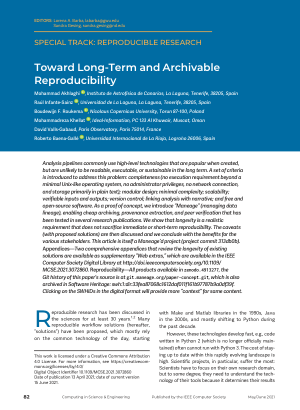
Toward Long-Term and Archivable Reproducibility
journalArticle · 2021 MAY
curation
"Criterion 1: Completeness. A project that is complete (self-contained)"p.84
open format
"Criterion 8: Free and open-source software (FOSS):"p.85
sustainability
"Criterion 3: Minimal complexity."p.84
versioning
"Criterion 6: Recorded history: No exploratory research is done in a single, first attempt. Projects evolve as they are being completed. Naturally, earlier phases of a project are redesigned/optimized "p.85
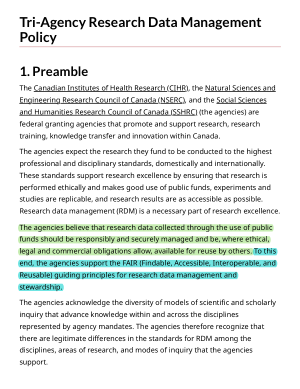
Tri-Agency Research Data Management Policy
webpage · 2025-12-19
Indigenous community engagement
"The principles of Ownership, Control, Access and Possession (OCAP®) are one model for First Nations data governance, but this model does not necessarily respond to the needs and values of distinct Fir"p.2
"data related to research by and with the First Nations, Métis, or Inuit whose traditional and ancestral territories are in Canada must be managed in accordance with data management principles develope"p.2
"recognizing that data created in the context of research by and with First Nations, Métis, and Inuit communities, collectives and organizations will be managed according to principles developed and ap"p.4
"For research conducted by and with First Nations, Métis and Inuit communities, collectives and organizations, DMPs must be co-developed with these communities, collectives and organizations, in accord"p.5
"For research conducted by and with First Nations, Métis and Inuit communities, collectives and organizations, these communities, collectives or organizations will guide and ultimately determine how th"p.6
access controls
"providing, or supporting access to, repository services or other platforms that securely preserve, curate and provide appropriate access to research data;"p.4
"However, the agencies expect researchers to provide appropriate access to the data where ethical, cultural, legal and commercial requirements allow, and in accordance with the FAIR principles and the "p.6
curation
"providing, or supporting access to, repository services or other platforms that securely preserve, curate and provide appropriate access to research data;"p.4
"in all cases the repository must ensure safe storage, preservation and curation of the data."p.6
data accessibility
"The agencies believe that research data collected through the use of public funds should be responsibly and securely managed and be, where ethical, legal and commercial obligations allow, available fo"p.1
"However, the agencies expect researchers to provide appropriate access to the data where ethical, cultural, legal and commercial requirements allow, and in accordance with the FAIR principles and the "p.6
data discovery
"To this end, the agencies support the FAIR (Findable, Accessible, Interoperable, and Reusable) guiding principles for research data management and stewardship."p.1
data handling ethics
"supporting researchers in their efforts to establish and implement data management practices that are consistent with ethical, legal and commercial obligations, as well as tri-agency requirements"p.3
"Finally, DMPs outline ethical, legal and commercial constraints the data are subject to, and methodological considerations that support or preclude data sharing."p.5
data sovereignty
"This includes, but is not limited to, considerations of Indigenous data sovereignty, as well as data collection, ownership, protection, use, and sharing."p.2
"DMPs in the context of research by and with First Nations, Métis and Inuit communities, collectives and organizations should recognize Indigenous data sovereignty and include options for renegotiation"p.5
data use compliance
"By accepting agency funds, institutions and researchers accept the terms and conditions as set out in the agencies' policies, agreements and guidelines. In the event of an alleged breach of agency pol"p.8
licensing and usage conditions
"Finally, DMPs outline ethical, legal and commercial constraints the data are subject to, and methodological considerations that support or preclude data sharing."p.5
open format
"To this end, the agencies support the FAIR (Findable, Accessible, Interoperable, and Reusable) guiding principles for research data management and stewardship."p.1
preservation
"providing, or supporting access to, repository services or other platforms that securely preserve, curate and provide appropriate access to research data;"p.4
"The deposit must be made by time of publication. The choice of repository may be guided by disciplinary expectations and the recipient's own judgment, but in all cases the repository must ensure safe "p.6
sustainability
"The agencies strongly support the creation of a robust and efficient environment for data stewardship in Canada and internationally."p.2
training resources
"promoting the importance of data management to researchers, staff and students;"p.4
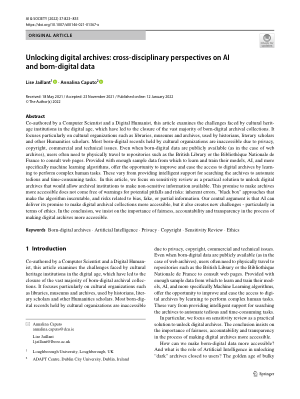
Unlocking digital archives: cross-disciplinary perspectives on AI and born-digital data
journalArticle · 2022-09
access controls
"Why not adopt a similar access system for born-digital records, especially records that are particularly sensitive, instead of closing entire collections? Users would provide their ID and relevant cre"p.829
free access
"On the side of the open access movement, some will argue that less problematic records such as web archives should be made freely available, not locked behind walls."p.829
machine-actionability
"Moreover, these resources are a response to the “collections as data” movement which has encouraged cultural heritage organizations to present collections in machine-readable formats."p.828
standardized metadata
"These metadata files feature contextual information including the date when the item was digitized, the technical material used to capture the images, and the method used for transcriptions—which were"p.828
Update of the Study on the readiness of research data and literature repositories to facilitate compliance with the Open Science Horizon Europe MGA requirements
report · 2024-10-14
certification
"The value in Column E “Trusted - Certified repository” will be “Yes” if the repository holds one or more acknowledged certifications, i.e. if in column S “Certification” is indicated one of the follow"p.2
curation
"the repository displays an online Public Policy for Preservation, Curation and Security of the content, and thus the value in column V is “Yes;"p.2
cybersecurity
"the repository displays an online Public Policy for Preservation, Curation and Security of the content, and thus the value in column V is “Yes;"p.2
designated community
"The value in Column F “Trusted - Community Endorsement” will be “Yes” if in Column L is indicated "Disciplinary", and if both in column T “Community Endorsement” and in column U “Internationally Recog"p.2
endorsement
"The value in Column F “Trusted - Community Endorsement” will be “Yes” if in Column L is indicated "Disciplinary", and if both in column T “Community Endorsement” and in column U “Internationally Recog"p.2
funder information
"the repository metadata allow reference to "Horizon Europe", i.e. the value in column AL is “Yes, through a separate field”"p.4
licensing and usage conditions
"the repository metadata contains a "License" field, i.e. the value in column X is “Yes”;"p.2
"metadata are open under a Creative Commons Public Domain Dedication (CC 0) or equivalent, i.e. the value in column AE is “Yes”;"p.4
machine-actionability
"the repository metadata are machine-actionable, i.e. the value in column Z is “Yes”;"p.2
persistent identifiers and citations
"the repository assigns persistent unique identifiers to contents, i.e. the value in column Y is “Yes”;"p.2
preservation
"the repository displays an online Public Policy for Preservation, Curation and Security of the content, and thus the value in column V is “Yes;"p.2
standardized metadata
"the repository metadata is standardised, i.e. the value in column AA is “Yes”."p.2
"the repository metadata are machine-actionable, i.e. the value in column Z is “Yes”;"p.2
Using semantic web technologies to power LungMAP, a molecular data repository
conferencePaper · 2017
free access
"open access data policy, and thus any visitor to the web application can search, download, and view data available through the LungMAP website"p.5
Where to keep research data: DCC checklist for evaluating data repositories
webpage · 22 January 2016
access controls
"Repository limits access according to conditions appropriate to the level of disclosure risk you inform them about ❑"p.16
"Access control: Enables depositors to restrict file/ object access and edit permissions to approved users for specific periods ❑ Enables depositors to restrict which users can access, edit, move or "p.17
"Level of access Accessible without user registration Accessible to authenticated users Accessible to authenticated users, using secure remote access or secure onsite room"p.7
anonymized data services
"Security requirement Suitable for fully anonymised data or data with agreement to publish personal details Partially anonymised data or data with agreement to publish personal details, and where"p.7
certification
"Points to consider Certification is relatively new - using the Re3data.org you can search for certified repositories. Certification standards are new however. There are many good repositories that ar"p.14
"Certified to an appropriate international standard ❑"p.14
continuity plans
"Continuity strategy: Enables data to be held in storage that’s backed-up to a different location ❑ Enables data to be stored in storage that’s backedup to two separate locations, one of which is loc"p.20
curation
"Data repositories are commonly thought of as offering different levels of curation and preservation. For example the Royal Society report ScienceasanOpenEnterprisetalks about ‘tiers of repository serv"p.12
cybersecurity
"Security requirement Suitable for fully anonymised data or data with agreement to publish personal details Partially anonymised data or data with agreement to publish personal details, and where"p.7
data discovery
"Discovery metadata:Provides Datacite mandatory metadata and exposes it according to open access repository protocols ❑ Provides metadata elements to enable broader discovery (e.g. geo-spatial) to re"p.19
"Content search: Supports common browse, search options across all collection content, using basic metadata terms ❑ Some content types may be searched on best practice metadata and retrieved content"p.21
data usage metrics
"Citation and usage tracking: Provides a publicly accessible landing page per dataset, with guidance on how to cite ❑ Provides usage statistics for access (e.g. page views) and for downloads of the da"p.21
"A repository should provide its depositors with an indication of how many times the data has been viewed and downloaded."p.21
documented APIs
"Metadata harvesting: Sufficient information can be harvested about data deposited with third-party repositories, to meet funders’ needs for metadata on locally produced data and its relation to othe"p.19
"Citation and usage tracking: Provides a publicly accessible landing page per dataset, with guidance on how to cite ❑ Provides usage statistics for access (e.g. page views) and for downloads of the da"p.21
"Data mining & visualisation: n/a Supports the extraction and visualisation of patterns in structured datasets, or of domain- relevant entities or terms ❑ Supports automatic discovery of semantical"p.22
endorsement
"Endorsed by a relevant funder, journal, or learned/ professional society ❑"p.14
legal compliance
"Legal terms and conditions"p.15
"Personal data or data which may identify individuals when linked to other data should not be stored outside the European Economic Area, unless in a legal jurisdiction that ensures personal data is a"p.16
"Legal conditions Under open licence, either Open Government Licence (OGL) for Crown Copyright data or Creative Commons for other data Requiring an End User Licence and, where appropriate, special "p.8
licensing and usage conditions
"Licensing: You can assign rights information to a collection, applying standard terms and a limited range of open access license options ❑ You can apply a standard end user licence and, where appr"p.16
open format
"file format - repositories commonly prefer open rather than proprietary formats; usually this is stated as a preference rather than a hard rule, but any format that carries licence conditions with cos"p.15
"The repository should commit to open standards for file formats,"p.19
persistent identifiers and citations
"Stable identifiers: Enables a DOI or other open standard identifier to be assigned to a landing page for each ingested dataset/ collection ❑ Supports assignment of related persistent IDs per datas"p.19
preservation
"Data repositories are commonly thought of as offering different levels of curation and preservation. For example the Royal Society report ScienceasanOpenEnterprisetalks about ‘tiers of repository serv"p.12
"In terms of preservation, the repository must have clear guidelines on what would happen to the data in the event that it ceases operation or changes its scope. That must include preserving the integr"p.19
"Data integrity & fixity: Enables a digital fingerprint (e.g. checksum) to be assigned to all files in collection when ingested ❑ Provides routine integrity checks, and documents the results ❑ Sup"p.20
"File checking and preservation planning: Supports virus check and file format validation at ingest, and provides format inventory ❑ Supports file normalisation to selected preservation formats ❑ Su"p.20
repository registry record
"Listed in the re3data or Biosharing registries, or broadly recognised in the research domain ❑"p.14
resource linking and relationships
"Metadata publishing: Data collections are catalogued in a repository according to funder expectations so that they are discoverable by title, creator, and date of deposition ❑ Repository publishes "p.18
semantic interoperability
"Metadata publishing: Data collections are catalogued in a repository according to funder expectations so that they are discoverable by title, creator, and date of deposition ❑ Repository publishes "p.18
"For domain repositories, that could include support for domain-specific metadata terms or vocabularies."p.19
"Domain metadata & context information:Supports linking of dataset to related records according to open repository protocols and standard identifiers ❑ Supports limited domainspecific metadata at re"p.20
standardized metadata
"Metadata publishing: Data collections are catalogued in a repository according to funder expectations so that they are discoverable by title, creator, and date of deposition ❑ Repository publishes "p.18
versioning
"In terms of preservation, the repository must have clear guidelines on what would happen to the data in the event that it ceases operation or changes its scope. That must include preserving the integr"p.19
"Version control: Ingested objects and latest edits are timestamped ❑ Change history for object and metadata is available on request ❑ Integrates with software versioning repository (e.g. Github) to"p.20
Working towards securing and building a trusted institutional research data repository through the CoreTrustSeal process: case of Cape Peninsula University of Technology data repository.
journalArticle · 2024-07-01
curation
"The library team does a basic level curation, but the quality and information in the actual dataset should be reviewed by an expert in the field."p.6
"Metadata Specialist does a further review on the metadata and assign the datasets to the Digital Scholarship Librarian."p.6
"Digital Scholarship Librarian receives the email notication, does a first level quality check of the metadata and datasets."p.6
cybersecurity
"housed within secure technical environments"p.2
data handling ethics
"Ethics Manager reviews the datasets as per the developed Ethics checklist and assign to the Digital Scholarship Librarian."p.6
preservation
"A preservation strategy is another important aspect to consider in securing and building trust in a research data repository, and one of the CTS requirements."p.6
standardized metadata
"Metadata Specialist does a further review on the metadata and assign the datasets to the Digital Scholarship Librarian."p.6
sustainability
"stable and sustainable platform"p.2
training resources
"To promote effective RDM practices, CPUT Libraries offered several training options. First, Faculty Support Teams were trained on the eSango data repository as well as on the Data Management Planning "p.7
by item count